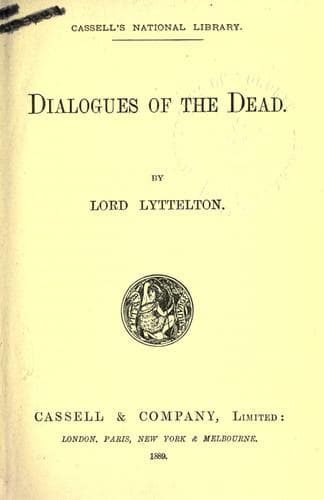
Dialogues of the DeadLyttelton, George Lyttelton, Baron
Philosophy
Dialogues of the Dead
Lyttelton, George Lyttelton, Baron
Dialogues, English -- Early works to 1800; Imaginary conversations
_Guise_.--Avaunt! thou fiend. I abhor thy sight. I look upon thee as
the original cause of my death, and of all the calamities brought upon
the French nation, in my father's time and my own.
_Machiavel_.--I the cause of your death! You surprise me!
_Guise_.--Yes. Your pernicious maxims of policy, imported from Florence
with Catherine of Medicis, your wicked disciple, produced in France such
a government, such dissimulation, such perfidy, such violent, ruthless
counsels, as threw that whole kingdom into the utmost confusion, and
ended my life, even in the palace of my sovereign, by the swords of
assassins.
_Machiavel_.--Whoever may have a right to complain of my policy, you,
sir, have not. You owed your greatness to it, and your deviating from it
was the real cause of your death. If it had not been for the
assassination of Admiral Coligni and the massacre of the Huguenots, the
strength and power which the conduct of so able a chief would have given
to that party, after the death of your father, its most dangerous enemy,
would have been fatal to your house; nor could you, even with all the
advantage you drew from that great stroke of royal policy, have acquired
the authority you afterwards rose to in the kingdom of France; but by
pursuing my maxims, by availing yourself of the specious name of religion
to serve the secret purposes of your ambition, and by suffering no
restraint of fear or conscience, not even the guilt of exciting a civil
war, to check the necessary progress of your well-concerted designs. But
on the day of the barricades you most imprudently let the king escape out
of Paris, when you might have slain or deposed him. This was directly
against the great rule of my politics, not to stop short in rebellion or
treason till the work is fully completed. And you were justly censured
for it by Pope Sixtus Quintus, a more consummate politician, who said,
"You ought to have known that when a subject draws his sword against his
king he should throw away the scabbard." You likewise deviated from my
counsels, by putting yourself in the power of a sovereign you had so much
offended. Why would you, against all the cautions I had given, expose
your life in a loyal castle to the mercy of that prince? You trusted to
his fear, but fear, insulted and desperate, is often cruel. Impute
therefore your death not to any fault in my maxims, but to your own folly
in not having sufficiently observed them.
Public-domain text, read in full here on John Shaqi.
Reviews
Reviews
No reviews yet
Be the first to share your thoughts on this work.
Join the Discussion
Join the discussion
Sign in to leave a comment or review.
Sign InorCreate an account