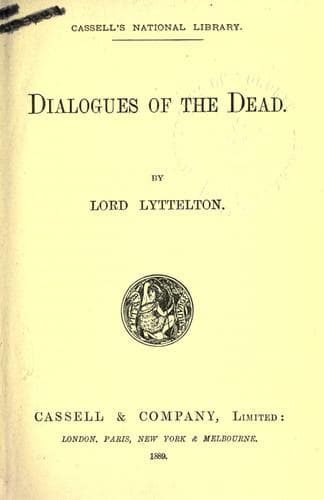
Dialogues of the DeadLyttelton, George Lyttelton, Baron
Philosophy
Dialogues of the Dead
Lyttelton, George Lyttelton, Baron
Dialogues, English -- Early works to 1800; Imaginary conversations
_Virgil_.--My dear Horace, your company is my greatest delight, even in
the Elysian Fields. No wonder it was so when we lived together in Rome.
Never had man so genteel, so agreeable, so easy a wit, or a temper so
pliant to the inclinations of others in the intercourse of society. And
then such integrity, such fidelity, such generosity in your nature! A
soul so free from all envy, so benevolent, so sincere, so placable in its
anger, so warm and constant in its affections! You were as necessary to
Maecenas as he to Augustus. Your conversation sweetened to him all the
cares of his ministry; your gaiety cheered his drooping spirits; and your
counsels assisted him when he wanted advice. For you were capable, my
dear Horace, of counselling statesmen. Your sagacity, your discretion,
your secrecy, your clear judgment in all affairs, recommended you to the
confidence, not of Maecenas alone, but of Augustus himself; which you
nobly made use of to serve your old friends of the republican party, and
to confirm both the minister and the prince in their love of mild and
moderate measures, yet with a severe restraint of licentiousness, the
most dangerous enemy to the whole commonwealth under any form of
government.
_Horace_.--To be so praised by Virgil would have put me in Elysium while
I was alive. But I know your modesty will not suffer me, in return for
these encomiums, to speak of your character. Supposing it as perfect as
your poems, you would think, as you did of them, that it wanted
correction.
_Virgil_.--Don't talk of my modesty. How much greater was yours, when
you disclaimed the name of a poet, you whose odes are so noble, so
harmonious, so sublime!
_Horace_.--I felt myself too inferior to the dignity of that name.
_Virgil_.--I think you did like Augustus, when he refused to accept the
title of king, but kept all the power with which it was ever attended.
Even in your Epistles and Satires, where the poet was concealed, as much
as he could be, you may properly be compared to a prince in disguise, or
in his hours of familiarity with his intimate friends: the pomp and
majesty were let drop, but the greatness remained.
_Horace_.--Well, I will not contradict you; and, to say the truth, I
should do it with no very good grace, because in some of my Odes I have
not spoken so modestly of my own poetry as in my Epistles. But to make
you know your pre-eminence over me and all writers of Latin verse, I will
carry you to Quintilian, the best of all Roman critics, who will tell you
in what rank you ought to be placed.
_Virgil_.--I fear his judgment of me was biassed by your commendation.
But who is this shade that Mercury is conducting? I never saw one that
stalked with so much pride, or had such ridiculous arrogance expressed in
his looks!
_Horace_.--They come towards us. Hail, Mercury! What is this stranger
with you?
_Mercury_.--His name is Julius Caesar Scaliger, and he is by profession a
critic.
Public-domain text, read in full here on John Shaqi.
Reviews
Reviews
No reviews yet
Be the first to share your thoughts on this work.
Join the Discussion
Join the discussion
Sign in to leave a comment or review.
Sign InorCreate an account