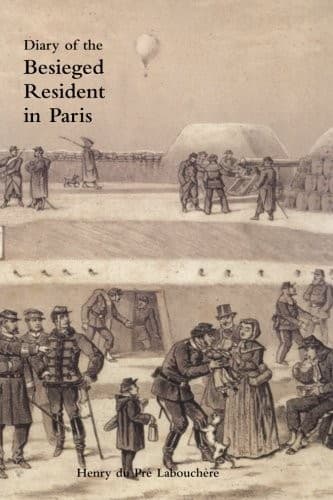
Diary of the Besieged Resident in ParisLabouchere, Henry Du Pré
History
Diary of the Besieged Resident in Paris
Labouchere, Henry Du Pré
Franco-Prussian War, 1870-1871; Paris (France) -- History -- Siege, 1870-1871 -- Personal narratives
General Vinoy, out reconnoitering with 15,000 men, came to-day upon a
Prussian force of 40,000 near Vincennes. After an artillery combat, he
withdrew within the lines of the forts. There have been unimportant
skirmishes with the enemy at several points. The American, the Belgian,
the Swiss, and the Danish Ministers are still here. Mr. Wodehouse has
remained to look after our interests. All the secretaries were anxious
to stay. I should be glad to know why Mr. Falconer Atlee, the British
Consul at Paris, is not like other consuls, at his post. He withdrew to
Dieppe about three weeks ago. His place is here. Neither a consul, nor a
soldier, should leave his post as soon as it becomes dangerous.
Victor Hugo has published an address to the nation. You may judge of its
essentially practical spirit by the following specimen:--"Rouen, draw
thy sword! Lille, take up thy musket! Bordeaux, take up thy gun!
Marseilles, sing thy song and be terrible!" I suspect Marseilles may
sing her song a long time before the effect of her vocal efforts will in
any way prevent the Prussians from carrying out their plans. "A child,"
say the evening papers, "deposited her doll this afternoon in the arms
of the statue of Strasburg. All who saw the youthful patriot perform
this touching act were deeply affected."
_September 19th._
I don't know whether my letter of yesterday went off or not. As my
messenger to the post-office could get no authentic intelligence about
what was passing, I went there myself. Everybody was in military
uniform, everybody was shrugging his shoulders, and everybody was in the
condition of a London policeman were he to see himself marched off to
the station by a street-sweeper. That the Prussian should have taken the
Emperor prisoner, and have vanquished the French armies, had, of course,
astonished these worthy bureaucrats, but that they should have ventured
to interfere with postmen had perfectly dumbfounded them. "Put your
letter in that box," said a venerable employe on a high stool. "Will it
ever be taken out?" I asked. "Qui sait?" he replied. "Shall you send off
a train to-morrow morning?" I asked. There was a chorus of "Qui sait?"
and the heads disappeared still further with the respective shoulders to
which they belonged. "What do you think of a man on horseback?" I
suggested. An indignant "Impossible" was the answer. "Why not?" I asked.
The look of contempt with which the clerks gazed on me was expressive.
It meant, "Do you really imagine that a functionary--a postman--is going
to forward your letters in an irregular manner?" At this moment a sort
of young French Jefferson Brick came in. Evidently he was a Republican
recently set in authority. To him I turned. "Citizen, I want my letter
to go to London. It is a press letter. These bureaucrats say that they
dare not send it by a horse express; I appeal to you, as I am sure you
are a man of expedients." "These people," he replied, scowling at the
clerks, "are demoralised.
Public-domain text, read in full here on John Shaqi.
Reviews
Reviews
No reviews yet
Be the first to share your thoughts on this work.
Join the Discussion
Join the discussion
Sign in to leave a comment or review.
Sign InorCreate an account