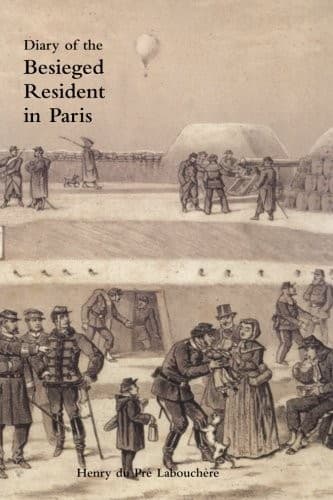
Diary of the Besieged Resident in Paris — John Shaqi
Diary of the Besieged Resident in ParisLabouchere, Henry Du Pré
History
Diary of the Besieged Resident in Paris
Labouchere, Henry Du Pré
Franco-Prussian War, 1870-1871; Paris (France) -- History -- Siege, 1870-1871 -- Personal narratives
They are the ancient valets of a corrupt
Court; give me your letter; if possible it shall go, 'foi de citoyen.'"
I handed my letter to Jefferson, but whether it is on its way to
England, or still in his patriotic hands, I do not know. As I passed out
through the courtyard I saw postmen seated on the boxes of carts, with
no horses before them. It was their hour to carry out the letters, and
thus mechanically they fulfilled their duty. English Government
officials have before now been jeered at as men of routine, but the most
ancient clerk in Somerset House is a man of wild impulse and boundless
expedient compared with the average of functionaries great and small
here. The want of "shiftiness" is a national characteristic. The French
are like a flock of sheep without shepherds or sheep-dogs. Soldiers and
civilians have no idea of anything except doing what they are ordered to
do by some functionary. Let one wheel in an administration get out of
order, and everything goes wrong. After my visit to the post-office I
went to the central telegraph office, and sent you a telegram. The clerk
was very surly at first, but he said that he thought a press telegram
would pass the wires. When I paid him he became friendly. My own
impression is that my twelve francs, whoever they may benefit, will not
benefit the British public.
From the telegraph-office I directed my steps to a club where I was
engaged to dine. I found half-a-dozen whist tables in full swing. The
conversation about the war soon, however, became general. "This is our
situation," said, as he dealt a hand, a knowing old man of the world, a
sort of French James Clay: "generally if one has no trumps in one's
hand, one has at least some good court cards in the other suits; we've
got neither trumps nor court cards." "Et le General Trochu?" some one
suggested. "My opinion of General Trochu," said a General, who was
sitting reading a newspaper, "is that he is a man of theory, but
unpractical. I know him well; he has utterly failed to organise the
forces which he has under his command." The general opinion about Trochu
seemed to be that he is a kind of M'Clellan. "Will the Garde Nationale
fight?" some one asked. A Garde National replied, "Of course there are
brave men amongst us, but the mass will give in rather than see Paris
destroyed. They have their families and their shops." "And the Mobiles?"
"The Mobiles are the stuff out of which soldiers are made, but they are
still peasants, and not soldiers yet." On the whole, I found the tone in
"fashionable circles" desponding. "Can any one tell me where Jules Favre
has gone?" I asked. Nobody could, though everybody seemed to think that
he had gone to the Prussian headquarters. After playing a few rubbers, I
went home to bed at about one o'clock. The streets were absolutely
deserted. All the cafes were shut.
Public-domain text, read in full here on John Shaqi.
Reviews
Reviews
No reviews yet
Be the first to share your thoughts on this work.
Join the Discussion
Join the discussion
Sign in to leave a comment or review.
Sign InorCreate an account