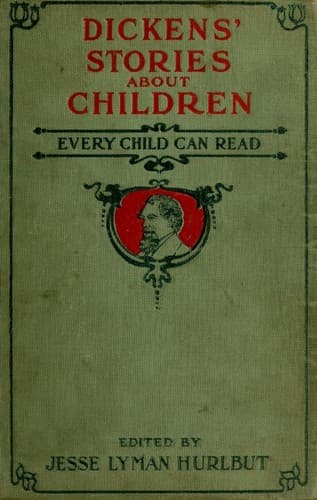
Dickens' Stories About Children Every Child Can Read — John Shaqi
Dickens' Stories About Children Every Child Can ReadDickens, Charles
General
Dickens' Stories About Children Every Child Can Read
Dickens, Charles
Children -- Juvenile fiction; Children's stories, English
"My child, I'll teach her for nothing," said the dancing-master,
shutting up the bag. He was as good-natured a dancing-master as ever
danced to the Insolvent Court, and he kept his word. The sister was so
apt a pupil, and the dancing-master had such abundant time to give her,
that wonderful progress was made. Indeed, the dancing-master was so
proud of it, and so wishful to show it before he left, to a few select
friends among the collegians (the debtors in the prison were called
"collegians"), that at six o'clock on a certain fine morning, an
exhibition was held in the yard--the college-rooms being of too small
size for the purpose--in which so much ground was covered, and the steps
were so well executed, that the dancing-master, having to play his
fiddle besides, was thoroughly tired out.
The success of this beginning, which led to the dancing-master's
continuing his teaching after his release, led the poor child to try
again. She watched and waited months for a seamstress. In the fullness
of time a milliner came in, sent there like all the rest for a debt
which she could not pay; and to her she went to ask a favor for
herself.
"I beg your pardon, ma'am," she said, looking timidly round the door of
the milliner, whom she found in tears and in bed: "but I was born here."
Everybody seemed to hear of her as soon as they arrived; for the
milliner sat up in bed, drying her eyes, and said, just as the
dancing-master had said:
"Oh! _you_ are the child, are you?"
"Yes, ma'am."
"I am sorry I haven't got anything for you," said the milliner, shaking
her head.
"It's not that, ma'am. If you please, I want to learn needlework."
"Why should you do that," returned the milliner, "with me before you? It
has not done me much good."
"Nothing--whatever it is--seems to have done anybody much good who comes
here," she returned in her simple way; "but I want to learn, just the
same."
"I am afraid you are so weak, you see," the milliner objected.
"I don't think I am weak, ma'am."
"And you are so very, very little, you see," the milliner objected.
"Yes, I am afraid I am very little indeed," returned the Child of the
Marshalsea; and so began to sob over that unfortunate smallness of
hers, which came so often in her way. The milliner--who was not unkind
or hardhearted, only badly in debt--was touched, took her in hand with
good-will, found her the most patient and earnest of pupils, and made
her a good workwoman.
Public-domain text, read in full here on John Shaqi.
Reviews
Reviews
No reviews yet
Be the first to share your thoughts on this work.
Join the Discussion
Join the discussion
Sign in to leave a comment or review.
Sign InorCreate an account