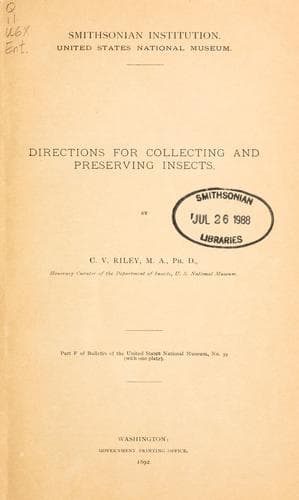
Directions for Collecting and Preserving InsectsRiley, Charles V. (Charles Valentine)
Science
Directions for Collecting and Preserving Insects
Riley, Charles V. (Charles Valentine)
Insects -- Collection and preservation
_Spring Flights of Coleoptera._--On the first really warm days of spring
commences the "swarming" season of Coleoptera, when all winged species
are flying about, especially toward evening. On favorable days the
number of specimens and species that can thus be found is astonishingly
great, and this is one of the few occasions when the Coleopterist can
advantageously use a light butterfly net. The flying beetles preferably
alight and rest on the top of wooden fences (especially newly made
ones), on the railings of bridges, etc., where they can be easily seen
and secured, or they are attracted in great numbers by the white-painted
surface of buildings. This flying season lasts in the latitude of
Washington from the end of April to the middle of June, but favorable
days are not of frequent occurrence, since a peculiar combination of
atmospheric conditions appears to be necessary to induce the Coleoptera
to fly about in great numbers.
_Beach collecting._--Along the shores of the ocean and the Great Lakes
untold numbers of Coleoptera and other insects fall at this season into
the water, and, if the tides, the currents, and the winds be favorable,
they are washed ashore by the waves on the sandy beaches, where they
often form windrows several inches in height and width. If the collector
is happy enough to be at the right place on the right day he has then
the opportunity to pick up hundreds of rare species within a very short
time and without any trouble. Many of the specimens thus washed ashore
are dead and decayed, but the majority are alive and in excellent
condition. This "beach collecting" affords also an excellent opportunity
for the Hymenopterist and Hemipterist to secure large numbers of rare
species, but favorable days are also here of rare occurrence.
_Attracting by Lights._--On the beaches, day and night flying insects
can thus be captured. Away from the beach night-flying Coleoptera can
best be collected at the electric lights of our cities; but, as in the
Lepidoptera, not all night-flying species are attracted by the light.
Gas and other lights also attract Coleoptera, and the various "light
traps" that have been devised and described can advantageously be used
for collecting these insects.
Public-domain text, read in full here on John Shaqi.
Reviews
Reviews
No reviews yet
Be the first to share your thoughts on this work.
Join the Discussion
Join the discussion
Sign in to leave a comment or review.
Sign InorCreate an account