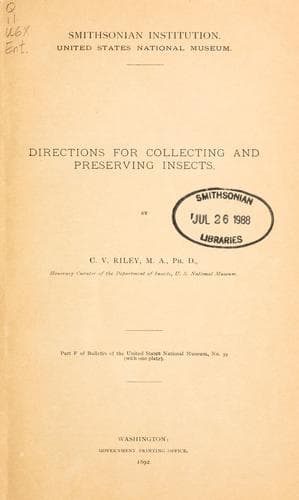
Directions for Collecting and Preserving InsectsRiley, Charles V. (Charles Valentine)
Science
Directions for Collecting and Preserving Insects
Riley, Charles V. (Charles Valentine)
Insects -- Collection and preservation
_Traps._--The method of "sugaring," so important to the Lepidopterist,
is by far less favorable for collecting Coleoptera. Still, certain rare
Carabidae, Elateridae, and Cerambycidae are attracted by this bait, and the
Coleopterist should not entirely ignore this mode of collecting. There
are a few other methods of trapping certain Coleoptera. By laying out
dead mammals, birds, fishes, snakes, etc., on suitable places and so
that they are protected from dogs, rats, etc., the carrion-feeding
Coleoptera can be found in great abundance, but a cleaner and less
disagreeable method of obtaining them is to bury in the ground tin cans
or glass jars so that the top is even with the surrounding ground and to
bait them with pieces of meat, fried fish, boiled eggs, etc. Many
Curculionidae, Scolytidae, and numerous other wood-inhabiting species can
be successfully trapped in the following way: A number of branches,
preferably of only one kind of tree, are cut and tied up into bundles of
convenient size. The bundles are then laid on the ground in a shady
place or firmly fastened on trunks of trees. When the cut branches begin
to get dry they will attract many of these Coleoptera, which can then be
readily collected by shaking the bundles out over the collecting cloth.
[Illustration: FIG. 65.--An Elaterid (_Pyrophorus noctilucus_). (From
Packard.)]
_Freshets._--Freshets usually take place in springtime in most of our
rivers and creeks, and furnish the means of obtaining a multitude of
Coleoptera, among which there will be many species which can not, or
only accidentally, be found otherwise. These freshets, sweeping over the
low banks or inundating wide stretches of low land, carry with them all
insects that have been caught by the inundation. Intermingled with, and
usually clinging to, the various floating debris, these insects are
eventually washed ashore by the current at various points and the
Coleopterist should not miss this rare opportunity, but go out to the
river bank at a time when the water is still rising, or at least when it
has attained its highest point. Among, or on the washed up debris, a
multitude of Coleoptera of various families can be found, and the
specimens can either be gathered up on the spot or a quantity of the
debris be put in sacks and taken home, where it can be examined more
thoroughly and with greater leisure than out of doors. A day or so after
the floods have receded the washed up specimens will have dispersed and
only a few will remain in the debris for a longer period. Still more
profitable than the spring floods are the summer freshets, because a
larger and more diversified lot of Coleoptera is then brought down by
the water. A similar opportunity for collecting is offered near the
seashore if unusually high tides inundate the low marshes along the
bayous and inlets.
[Illustration: FIG. 66.--A Longicorn (_Prionus laticollis_).]
Public-domain text, read in full here on John Shaqi.
Reviews
Reviews
No reviews yet
Be the first to share your thoughts on this work.
Join the Discussion
Join the discussion
Sign in to leave a comment or review.
Sign InorCreate an account