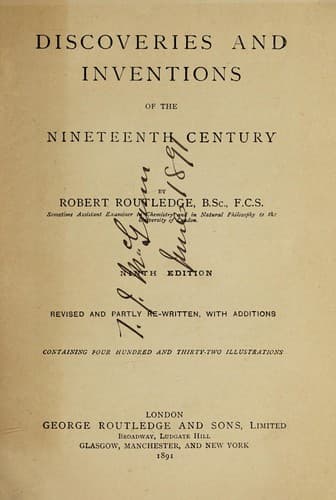
Discoveries and Inventions of the Nineteenth CenturyRoutledge, Robert
History
Discoveries and Inventions of the Nineteenth Century
Routledge, Robert
Inventions -- History -- 19th century
PLATE XII.
THE 110–TON ARMSTRONG GUN 202
PLATE XIII.
THE FORTH BRIDGE 292
PLATE XIV.
THE TOWER BRIDGE IN COURSE OF CONSTRUCTION 298
PLATE XV.
THE BROOKLYN BRIDGE 304
PLATE XVI.
THE NORTH MOUTH OF THE GREAT TUNNEL, ST. GOTHARD RAILWAY 374
PLATE XVII.
SPECTRA (Coloured Plate) 422
[Illustration:
_Wind, Steam, and Speed_ (after TURNER).
]
INTRODUCTION.
Only by knowledge of Nature’s laws can man subjugate her powers and
appropriate her materials for his own purposes. The whole history of
arts and inventions is a continued comment on this text; and since the
knowledge can be obtained only by observation of Nature, it follows that
Science, which is the exact and orderly summing-up of the results of
such observation, must powerfully contribute to the well-being and
progress of mankind.
Some of the services which have been rendered by science in promoting
human welfare are thus enumerated by an eloquent writer: “It has
lengthened life; it has mitigated pain; it has extinguished diseases; it
has increased the fertility of the soil; it has given new securities to
the mariner; it has furnished new arms to the warrior; it has spanned
great rivers and estuaries with bridges of form unknown to our fathers;
it has guided the thunderbolt innocuously from heaven to earth; it has
lighted up the night with the splendour of the day; it has extended the
range of the human vision; it has multiplied the power of the human
muscles; it has accelerated motion; it has annihilated distance; it has
facilitated intercourse, correspondence, all friendly offices, all
dispatch of business; it has enabled man to descend to the depths of the
sea, to soar into the air, to penetrate securely into the noxious
recesses of the earth, to traverse the land in cars which whirl along
without horses, to cross the ocean in ships which run ten knots an hour
against the wind. These are but a part of its fruits, and of its
first-fruits; for it is a philosophy which never rests, which has never
attained, which is never perfect. Its law is progress. A point which
yesterday was invisible is its goal to-day, and will be its
starting-point tomorrow.”—(MACAULAY).
Public-domain text, read in full here on John Shaqi.
Reviews
Reviews
No reviews yet
Be the first to share your thoughts on this work.
Join the Discussion
Join the discussion
Sign in to leave a comment or review.
Sign InorCreate an account