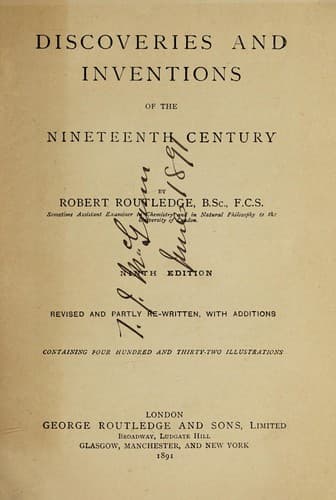
Discoveries and Inventions of the Nineteenth CenturyRoutledge, Robert
History
Discoveries and Inventions of the Nineteenth Century
Routledge, Robert
Inventions -- History -- 19th century
Thus every new invention, every triumph of engineering skill, is the
embodiment of some scientific idea; and experience has proved that
discoveries in science, however remote from the interests of every-day
life they may at first appear, ultimately confer unforeseen and
incalculable benefits on mankind. There is also a reciprocal action
between science and its application to the useful purposes of life; for
while no advance is ever made in any branch of science which does not
sooner or later give rise to a corresponding improvement in practical
art, so on the other hand every advance made in practical art furnishes
the best illustration of scientific principles.
The enormous material advantages which this age possesses, the cheapness
of production that has placed comforts, elegancies, and refinements
unknown to our fathers within the reach of the humblest, are traceable
in a high degree to the arrangement called the “division of labour,” by
which it is found more advantageous for each man to devote himself to
one kind of work only; to the steam engine and its numerous
applications; to increased knowledge of the properties of metals, and of
the methods of extracting them from their ores; to the use of powerful
and accurate tools; and to the modern plan of manufacturing articles by
processes of copying, instead of fashioning everything anew by manual
labour. Little more than a century ago everything was slowly and
imperfectly made by the tedious toil of the workman’s hand; but now
marvellously perfect results of ingenious manufacture are in every-day
use, scattered far and wide, so that their very commonness almost
prevents us from viewing them with the attention and admiration they
deserve. Machinery, actuated by the forces of nature, now performs with
ease and certainty work that was formerly the drudgery of thousands.
Every natural agent has been pressed into man’s service: the winds, the
waters, fire, gravity, electricity, light itself.
But so much have these things become in the present day matters of
course, that it is difficult for one who has not witnessed the
revolution produced by such applications of science to realize their
full importance. Let the young reader who wishes to understand why the
present epoch is worthy of admiration as a stage in the progress of
mankind, address himself to some intelligent person old enough to
remember the century in its teens; let him inquire what wonderful
changes in the aspect of things have been comprised within the
experience of a single lifetime, and let him ask what has brought about
these changes. He will be told of the railway, and the steam-ship, and
the telegraph, and the great guns, and the mighty ships of war—
“The armaments which thunderstrike the walls
Of rock-built cities, bidding nations quake,
And monarchs tremble in their capitals.”
Public-domain text, read in full here on John Shaqi.
Reviews
Reviews
No reviews yet
Be the first to share your thoughts on this work.
Join the Discussion
Join the discussion
Sign in to leave a comment or review.
Sign InorCreate an account