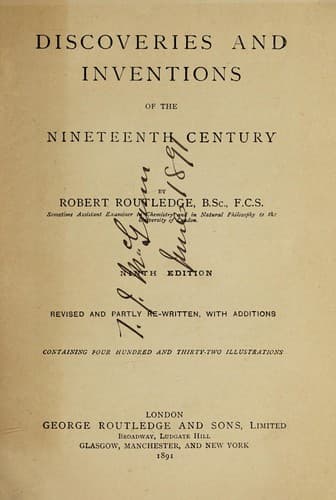
Discoveries and Inventions of the Nineteenth CenturyRoutledge, Robert
History
Discoveries and Inventions of the Nineteenth Century
Routledge, Robert
Inventions -- History -- 19th century
He will be told of a machine more potent in shaping the destinies of our
race than warlike engines—the steam printing-press. He may hear of a
chemistry which effects endless and marvellous transformations; which
from dirt and dross extracts fragrant essences and dyes of resplendent
hue. He may hear something of a wonderful instrument which can make a
faint beam of light, reaching us after a journey of a thousand years,
unfold its tale and reveal the secrets of the stars. Of these and of
other inventions and discoveries which distinguish the present age it is
the purpose of this work to give some account.
[Illustration: JAMES WATT]
STEAM ENGINES.
To track the steps which led up to the invention of the Steam Engine,
and fully describe the improvements by which the genius of the
illustrious Watt perfected it at least in principle, are not subjects
falling within the province of this work, which deals only with the
discoveries and inventions of the present century. But as it does enter
into our province to describe some of the more recent developments of
Watt’s invention, it may be desirable to give the reader an idea of his
engine, of which all the more recent applications of steam are
modifications, with improvements of detail rather than of principle.
Watt took up the engine in the condition in which it was left by
Newcomen; and what that was may be seen in Fig. 2, which represents
Newcomen’s atmospheric engine—the first practically useful engine in
which a piston moving in a cylinder was employed. In the cut, the lower
part of the cylinder, _c_, is removed, or supposed to be broken off, in
order that the piston, _h_, and the openings of the pipes, _d_, _e_,
_f_, connected with the cylinder, may be exhibited. The steam was
admitted beneath the piston by the attendant turning the cock _k_, and
as the elastic force of the steam was only equal to the pressure of the
atmosphere, it was not employed to raise the piston, but merely filled
the cylinder, the ascent of the piston being caused by the weight
attached to the other side of the beam, which at the same time sent down
the pump-rod, _m_; and when this was at its lowest position, the piston
was nearly at the top of the cylinder, which was open. The attendant
then cut off the communication with the boiler by closing the cock, _k_,
at the same time opening another cock which allowed a jet of cold water
from the cistern, _g_, to flow through the opening, _d_, into the
cylinder. The steam which filled the cylinder was, by contact with the
cold fluid, instantly condensed into water; and as the liquefied steam
would take up little more than a two-thousandth part of the space it
occupied in the gaseous state, it followed that a vacuum was produced
within the cylinder; and the weight of the atmosphere acting on the top
of the piston, having no longer the elastic force of the steam to
counteract it, forced the piston down, and thus raised the pump-bucket
Public-domain text, read in full here on John Shaqi.
Reviews
Reviews
No reviews yet
Be the first to share your thoughts on this work.
Join the Discussion
Join the discussion
Sign in to leave a comment or review.
Sign InorCreate an account