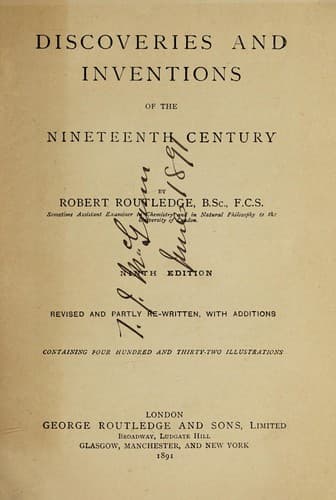
Discoveries and Inventions of the Nineteenth CenturyRoutledge, Robert
History
Discoveries and Inventions of the Nineteenth Century
Routledge, Robert
Inventions -- History -- 19th century
Steam engines are constructed in a great variety of forms, adapted to
the purposes for which they are intended. Distinctions are made
according as the engine is fitted with a condenser or not. When steam of
a low pressure is employed, the engine always has a condenser, and as in
this way a larger quantity of work is obtainable for a given weight of
fuel, all marine engines—and all stationary engines, where there is an
abundant supply of water and the size is not objectionable—are provided
with condensers. High-pressure steam may be used with condensing
engines, but is generally employed in non-condensing engines only, as in
locomotives and agricultural engines, the steam being allowed to escape
into the air when it has driven the piston to the end of the stroke. In
such engines the beam is commonly dispensed with, the head of the
piston-rod moving between guides and driving the crank directly by means
of a connecting-rod. The axis of the cylinder may be either vertical,
horizontal, or inclined. A plan often adopted in marine engines, by
which space is saved, consists in jointing the piston-rod directly to
the crank, and suspending the cylinder on trunnions near the middle of
its length. The trunnions are hollow, and are connected by steam-tight
joints, one with the steam-pipe from the boiler, and the other with the
eduction-pipe. Such engines have fewer parts than any others; they are
lighter for the same strength, and are easily repaired. The trunnion
joints are easily packed, so that no leakage takes place, and yet there
is so little friction that a man can with one hand move a very large
cylinder, whereas in another form of marine engine, known as the
side-lever engine, constructed with oscillating beams, the friction is
often very great.
_THE LOCOMOTIVE._
Public-domain text, read in full here on John Shaqi.
Reviews
Reviews
No reviews yet
Be the first to share your thoughts on this work.
Join the Discussion
Join the discussion
Sign in to leave a comment or review.
Sign InorCreate an account