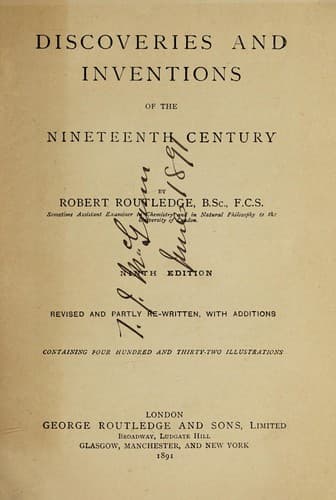
Discoveries and Inventions of the Nineteenth CenturyRoutledge, Robert
History
Discoveries and Inventions of the Nineteenth Century
Routledge, Robert
Inventions -- History -- 19th century
great velocity with which they pass through the atmosphere, whereby the
air in front of them is condensed and heated, the heat often being
sufficient to liquefy or even vaporize the solid matter. The so-called
shooting stars are with good reason believed to be nothing but such
incandescent aerolites, and the aerolites themselves are regarded as
small asteroids, or scattered planetary dust, portions of which
occasionally coming within the sphere of the earth’s attraction are
drawn to its surface. Meteoric iron is too rare to be of any value as a
source of iron, but certain specimens have been found in which the metal
was malleable and of excellent quality. From such meteorites the natives
of India and other places have, it is said, sometimes forged weapons of
wonderful temper and keenness, and we may well imagine that when such
weapons have been made from iron that had actually been observed to fall
from the sky, they would be regarded as endowed with magical powers, so
that we may perhaps ascribe to such circumstances the origin of some of
the legends about enchanted swords, etc. It is significant also that in
some Egyptian inscriptions of the very highest antiquity, the word
indicating iron has for its literal meaning _stone of the sky_.
But as nature has hardly provided man with the _metal_ iron, he has been
obliged to find the art of extracting it from substances which are
utterly unlike the metal itself. In this case, as in many others, the
art has been discovered and practised ages before any scientific
knowledge of the nature of the processes employed had been acquired. The
idea prevails that there are such difficulties in extracting this metal;
that elaborate and complex appliances, not unlike those in use in modern
times, were requisite for the purpose; and therefore that the use of
iron is compatible only with a somewhat late period in man’s history,
and implies a comparatively advanced stage of civilization. Now there
undoubtedly are facts which tend to confirm this view; for instance, the
Spaniards who first colonized North America found the natives perfectly
familiar with the use of copper, but without any acquaintance with iron,
although the region abounded with the finest ferruginous minerals; and,
again, the archæologists who have examined the relics of ancient
civilizations and of pre-historic peoples about the shores of the
Mediterranean, find in the earliest of these relics weapons and
implements of rudely chipped stones, followed later by the use of
better-shaped and polished stones; hence the periods represented by
these, they have respectively designated by the terms _palæolithic_ and
_neolithic_—the old and the new stone ages. At some later time the stone
of these implements was gradually replaced by _bronze_, which is a
mixture of copper and tin, while as yet iron does not occur in any form
among the remains. In the latest layers, however, articles of iron are
Public-domain text, read in full here on John Shaqi.
Reviews
Reviews
No reviews yet
Be the first to share your thoughts on this work.
Elsewhere in the archive
Join the Discussion
Join the discussion
Sign in to leave a comment or review.
Sign InorCreate an account