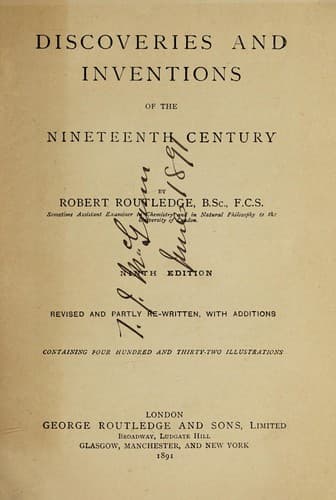
Discoveries and Inventions of the Nineteenth CenturyRoutledge, Robert
History
Discoveries and Inventions of the Nineteenth Century
Routledge, Robert
Inventions -- History -- 19th century
found, and it is inferred that this metal came into use only after
bronze had been known for an indefinite period; hence these later
pre-historic periods have come to be respectively called _the bronze
age_ and _the iron age_. No doubt this succession really occurred in the
localities where the observations were made, but it would not be
justifiable to assume that the same was the case in every part of the
world, for much would depend on such circumstances as the presence or
absence of the essential minerals. We may also set against the supposed
difficulty of obtaining iron from the ores, the still greater complexity
of the methods required for the production of copper and of tin. Besides
this is the fact that the ores of tin are found but in very few places
in the world, and of these only the Cornwall mines, so well known in
ancient times, would be likely to furnish a supply to the places where
pre-historic bronzes are found; this implies that navigation and
commerce must have already made considerable progress. On the other
hand, iron has been produced and worked for untold ages by the negro
races all over Central Africa, and the method of treating the ore has no
doubt been that which is there still practised by certain scarcely
civilized tribes, and it is as simple as any metallurgical operation can
possibly be, requiring merely a hole dug in a clay bank, wherein the
fuel and minerals are piled up, and the mere wind supplies sufficient
blast to urge the fire to the needful temperature, or air is blown in
from rude bellows made of a pair of skins alternately raised and
compressed. These very primitive furnaces have in some places developed
into permanent clay structures, seven or eight feet in height. The
natives of Central Africa have therefore long known the method of
extracting iron, as well as of forging and casting it.
Public-domain text, read in full here on John Shaqi.
Reviews
Reviews
No reviews yet
Be the first to share your thoughts on this work.
Elsewhere in the archive
Join the Discussion
Join the discussion
Sign in to leave a comment or review.
Sign InorCreate an account