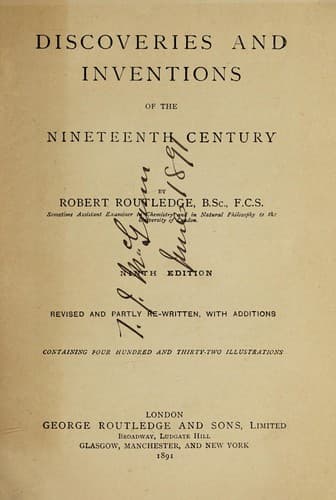
Discoveries and Inventions of the Nineteenth CenturyRoutledge, Robert
History
Discoveries and Inventions of the Nineteenth Century
Routledge, Robert
Inventions -- History -- 19th century
The nature and value of what has been done during the century in the
treatment of iron would not be intelligible without some description of
the ordinary processes of extracting the metal from the ores; and a
scientific understanding of these implies some acquaintance with
chemistry. Not because metallurgy has been developed from chemistry, for
the fact is rather the reverse; indeed, as we have seen, the art of
extracting iron from its ores was practised ages before chemistry as a
science was dreamt of. Although we may assume that many of our readers
have sufficient knowledge of chemistry to attach distinct ideas to such
few chemical terms as we shall have occasion to use, yet it may be of
advantage to others to have some preliminary notes of the character of
the chemical actions, and of some properties of the substances that will
have to be referred to. It is certainly the case that people in general,
and even people very well informed in other subjects, have but the
vaguest notions of the nature of chemical actions, and of the meaning of
the terms belonging to that science. For example, one of our most
popular and justly esteemed writers, treating of the very subject of
iron extraction, calls the ore a _matrix_, thereby implying that the
iron as metal is disseminated in detached fragments throughout the mass,
which is a conception inconsistent with the facts. The reader will be in
a more advantageous position for understanding the relation of the ores
of iron to the metal, if he will follow in imagination, or still better
in reality, a few observations and experiments like the following—of
which, however, he is recommended not to attempt the chemical part
unless he is himself practically familiar with the performance of
chemical operations, or can obtain the personal assistance of someone
who is. Taking, say, a few common iron nails, let him note some obvious
properties they possess: they have weight—are hard and tough so that
they cannot be crushed in a mortar—are opaque to light—if a smooth
surface be produced on any part, it will show that peculiar shiny
appearance which is called metallic lustre, in this case without any
decided colour—they are not dissolved by water as sugar or salt is—and
are attracted by a magnet. If several of the nails be heated to bright
redness they may be hammered on an anvil into one mass, and this may be
flattened out into a thin plate, or it may be shaped into a slender rod
and then drawn out into wire; or otherwise the nails may be converted
into the small fragments called iron filings. In these several forms the
nails, as nails, will have ceased to exist; but the material of which
they were formed will remain unchanged, and each and every part of it
however large or small will continue to exhibit all the properties noted
above as belonging to the substance of the nails, which in the cases
supposed has undergone merely _physical_ change of shape. Treating our
Public-domain text, read in full here on John Shaqi.
Reviews
Reviews
No reviews yet
Be the first to share your thoughts on this work.
Elsewhere in the archive
Join the Discussion
Join the discussion
Sign in to leave a comment or review.
Sign InorCreate an account