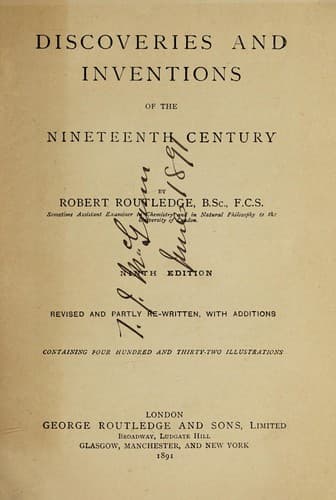
Discoveries and Inventions of the Nineteenth CenturyRoutledge, Robert
History
Discoveries and Inventions of the Nineteenth Century
Routledge, Robert
Inventions -- History -- 19th century
from them the iron in metallic state. Nay more, we should find the
weight of metal so obtained to be exactly equal to that of the pure iron
dissolved from the original nails, supposing of course that we operated
upon the whole of the crystalline matter so produced. The inference
therefore is that although every property of the iron appeared to be
absent from the crystals, the iron entering in them retained there its
original weight, and the correct statement of the change would be, that
in the crystals the iron had lost all its original properties SAVE ONE,
namely, its weight, or gravitating force, if we choose to call it so, a
property belonging to it in common with every material substance.
Chemical analysis can also separate from the crystals their other
constituents and weigh them apart—so much water and so much sulphuric
acid—and when to these weights that of the iron is added, the sum
exactly makes up the weight of the crystals.
A still simpler experiment, which may be performed by anyone with the
greatest ease, may serve as a further illustration of the profound
nature of the change in the properties of bodies brought about by
chemical combination, and it will also serve as the occasion of
directing attention to a remarkable circumstance that invariably
characterizes such changes, and one that should always be present in our
minds when we are considering them. A yard of flat _magnesium_ wire can
be bought for a few pence, and after its metallic character has been
observed in the silvery lustre disclosed by scraping the dull white
surface, a few inches is to be held vertically by a pair of tongs, or by
inserting one extremity in a cleft at the end of a stick, then the lower
part is brought into contact with a candle or gas flame. The metal will
instantly burn with a dazzlingly brilliant light, and some white smoke
(really fine white solid particles) will float into the air; but if a
plate be held under the burning metal, some of the smoke will settle
upon it, together with white fragments that have preserved some shape of
the metallic ribbon, but which a touch will reduce into a fine white
powder, identical with the well-known domestic medicine called “calcined
magnesia”—a substance totally different from the _metal magnesium_. The
reader will scarcely require to be told that in this burning the metal
is entering into combination with the oxygen of the air—by which that
invisible gas somehow becomes fixed in these solid white particles, so
entirely unlike itself. But this experiment might be so arranged that
the quantities of magnesium and oxygen entering into the magnesia could
be weighed. For this purpose special appliances would be required in
order to ensure complete combustion of the metal, for in the experiment
as just described some small particles are liable to be shielded from
the oxygen by a covering of magnesia, and the arrangement would have to
be such that the _whole_ of the white powder could be gathered up and
weighed.
Public-domain text, read in full here on John Shaqi.
Reviews
Reviews
No reviews yet
Be the first to share your thoughts on this work.
Elsewhere in the archive
Join the Discussion
Join the discussion
Sign in to leave a comment or review.
Sign InorCreate an account