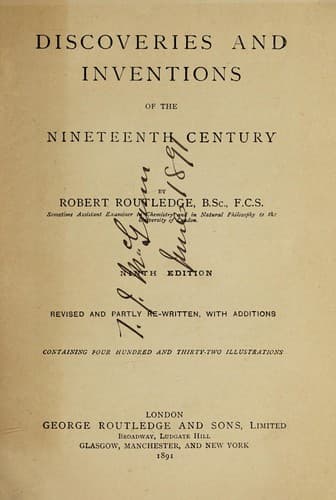
Discoveries and Inventions of the Nineteenth CenturyRoutledge, Robert
History
Discoveries and Inventions of the Nineteenth Century
Routledge, Robert
Inventions -- History -- 19th century
In the absence of such appliances, and of a delicate balance,
together with the skill requisite for their use, the reader must for the
time be contented to take our word for what would be the result. In
every experiment the magnesia would be found heavier than the metal
burned in the proportion of 5 to 3; in other words, magnesia always
contains (so the phrase runs) 3 parts of magnesium combined with 2 of
oxygen: never more nor less. A definite proportion between the weights
of the constituent substances characterizes every chemical combination,
and when this is once determined in a single sample of the compound, it
is determined for every portion of the same, wherever found or however
produced. But each compound has its own particular proportion, that is,
the quantitative relations are different for each. For example, the two
constituents of water, hydrogen and oxygen, are combined in the ratio of
1 to 8, etc.; and oxygen combines with metals in a ratio different in
each case. Then occasionally the same ratio of constituents occurs in
compounds of different composition. The elementary student is apt to
suppose that this is _because_ of the _law_ which he finds stated,
probably in almost the first page of his text-book: “Every compound
contains its elements in definite and invariable proportions”; and even
well-educated people entertain the idea of the fact being “governed by”
or “obeying” the law just quoted,—a misconception arising from the other
use of the word “law,” as signifying an enactment. The real case however
is the converse; namely, that a multitude of facts like that above
stated have governed the law, and caused it to be what it is—the general
statement of many observed facts.
Public-domain text, read in full here on John Shaqi.
Reviews
Reviews
No reviews yet
Be the first to share your thoughts on this work.
Elsewhere in the archive
Join the Discussion
Join the discussion
Sign in to leave a comment or review.
Sign InorCreate an account