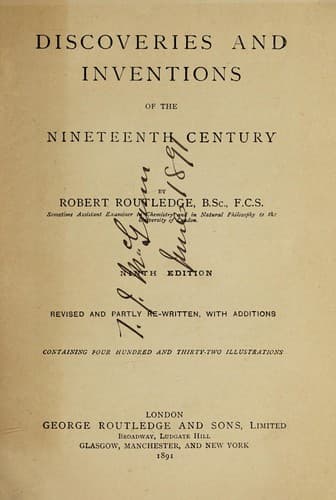
Discoveries and Inventions of the Nineteenth CenturyRoutledge, Robert
History
Discoveries and Inventions of the Nineteenth Century
Routledge, Robert
Inventions -- History -- 19th century
We have assumed that the reader’s chemical knowledge had already made
him aware that in every case of ordinary combustion the oxygen of the
atmosphere is in the act of entering into combination with the burning
body: as with the magnesium, so with a coal fire, a gas flame, or a
burning candle; only in these last cases the products of the combustion
pass away invisibly. The candle by burning disappears from sight, but
its matter is not lost, and as in the case of magnesium, the compounds
it forms weigh more than the unburnt candle. The experiment is commonly
shown in courses of elementary lectures on chemistry, of so burning a
candle that the invisible products are retained in the apparatus,
instead of being dissipated in the atmosphere, and the increase of
weight of the burnt candle over the original one is demonstrated by the
balance. Important as is the part played by oxygen in all chemical
actions on the earth, the composition of the atmosphere was not
understood until the end of the eighteenth century, and it was well on
into the nineteenth before the quantities of its constituents were
accurately determined. Now everyone knows that air is mainly made up of
a _mixture_ of the two gases _oxygen_ and _nitrogen_. A _mixture_ of two
or more things is very different from a chemical _combination_ of them;
for in the former each ingredient retains its own properties. (See _Air_
in Index.) Nitrogen being an inert gas that takes no part in combustion,
or in the ordinary chemical actions of the air, acts therein simply as a
diluent of the oxygen. It is necessary in relation to our present
subject to bear this in mind, as well as the relative quantities of the
two gases in air. For our immediate purpose we may neglect the minor
constituents of air—such as watery vapour, carbonic acid, etc., of which
the total weight does not exceed one hundredth part of the whole—and
consider air as a mixture of 23 parts by weight of oxygen with 77 of
nitrogen, or calculated in volumes, 21 measures of oxygen with 79 of
nitrogen. Compounds of oxygen with nearly every one of the other seventy
or more chemical elements are known, and these compounds, which are
called _oxides_, are arranged by chemists under five or six classes,
forming as they do _basic radicles_, _acid radicles_, _saline oxides_,
etc. With some of these compounds belonging to different classes, we
must make acquaintance after noticing the elementary substance with
which the oxygen is united.
Public-domain text, read in full here on John Shaqi.
Reviews
Reviews
No reviews yet
Be the first to share your thoughts on this work.
Elsewhere in the archive
Join the Discussion
Join the discussion
Sign in to leave a comment or review.
Sign InorCreate an account