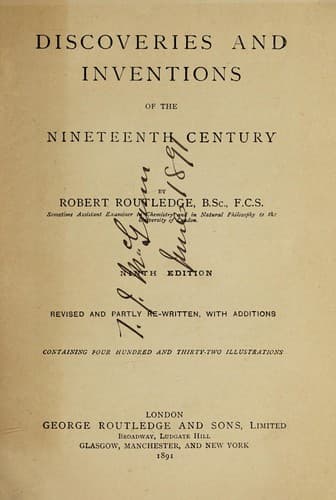
Discoveries and Inventions of the Nineteenth CenturyRoutledge, Robert
History
Discoveries and Inventions of the Nineteenth Century
Routledge, Robert
Inventions -- History -- 19th century
We begin with _carbon_, which forms the chief constituent of all our
combustibles. Some specimens of graphite, plumbago, or “blacklead”
consist of almost pure carbon (98 per cent.), and some varieties of wood
charcoal exceptionally contain 96 per cent.; but in ordinary charcoal
the percentage is much less. Coal, the most familiar of our solid fuels,
varies greatly in composition, carbon being the predominating
constituent, in amount from 57 to 93 per cent. Coke, another fuel much
used in metallurgical operations, is made by heating coal without access
of air, when a large quantity of gaseous substances is expelled. Coke
burns with an intense and steady heat without emitting any visible
smoke, but it does not ignite as readily as coal. Carbon forms two
different compounds with oxygen: both are invisible gases, but they
differ in the proportions of the constituents, and present different
properties. When carbon (coal, coke, or charcoal) is completely burnt,
that is, with an abundant supply of air, the product is _carbonic acid_
gas, in which 3 parts of carbon are combined with 8 of oxygen: when, on
the other hand, the carbon is burnt with a sufficiently restricted
access of air, the result is _carbonic oxide_ gas, in which 3 parts of
carbon are united with only 4 of oxygen. The reader will here observe
that the former contains just twice as much oxygen as the latter for the
same quantity of carbon. This fact and numberless others like it are
expressed or summed up by another _law_ of chemical combination which
states that when two elements combine in several different proportions
these are invariably such that the ratios in the several compounds will
be found to have exact and simple numerical relations; that is, such as
may, when reduced to their lowest terms, be expressed by the simple
integers 1, 2, 3, etc., as 1 : 2, 3 : 2; ... 8 : 9, etc. It comes to the
same thing if we compare together the weights A and A´ which are united
in each compound with any one identical weight of B, giving of course
the ratio A : B ÷ A´ : B. For instance, in the case just given, of
carbon and oxygen, 3 : 4 ÷ 3 : 8 = 2 : 1. This, which is simply stating
the facts, is called the _law of multiple proportions_. On a later page
will be found another illustration (see Index, _Nitrogen and Oxygen
Compounds_), and its expression in terms of the _atomic theory_, which
goes behind the facts (so to speak), but is extremely useful by
comprehending many other groups of facts in chemistry and in other
sciences. Carbonic acid gas is of course incombustible, but carbonic
oxide gas burns by uniting with the additional proportion of oxygen and
becoming carbonic acid. On the other hand, carbonic acid gas passing
over red-hot coals takes up from them the additional proportion of
carbon, and is, we may say, _unburnt_ into carbonic oxide. When we see a
pale blue flame flickering over the bright embers in a fire grate, it is
Public-domain text, read in full here on John Shaqi.
Reviews
Reviews
No reviews yet
Be the first to share your thoughts on this work.
Elsewhere in the archive
Join the Discussion
Join the discussion
Sign in to leave a comment or review.
Sign InorCreate an account