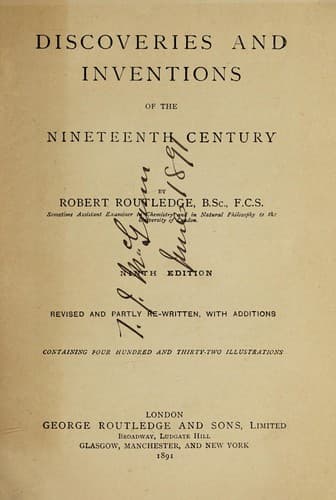
Discoveries and Inventions of the Nineteenth CenturyRoutledge, Robert
History
Discoveries and Inventions of the Nineteenth Century
Routledge, Robert
Inventions -- History -- 19th century
carbonic oxide burning back again by taking more oxygen from the air
above the coals. Carbonic oxide combines directly with two or three of
the metals, as, for instance, it forms a volatile compound with nickel,
at a certain temperature, and this is decomposed again at a higher
temperature. The like takes place with iron, although in very small
quantities, but the observation throws some light on the processes of
reduction. Carbonic oxide is neither acid nor basic, but carbonic acid
is an acid oxide, and as such unites with oxides of the basic class to
form another range of compounds. Thus, for example, the oxide of the
metal _calcium_ is quicklime, which is strongly basic, and this directly
combines with carbonic acid, forming a _neutral_ substance called in
systematic chemistry _calcium carbonate_, or more commonly but less
correctly, carbonate of lime, familiar to everyone in the compact state
as limestone, and marble, and in a more or less pulverent condition as
chalk. When any of these is heated to redness, carbonic acid is expelled
and quicklime remains. Like most oxides, quicklime forms a compound with
water, the combination being attended with the extrication of much heat,
the compact quicklime swelling and crumbling into _slaked lime_. The
chemist’s term for a compound of a _basic_ oxide with water is
_hydrate_, while that of an _acid_ oxide with water is for him properly
an _acid_, or in order to particularly distinguish this class, an
_oxy-acid_. It was however the older practice to give the name of acid
to the oxide alone, and this naming having found its way into popular
language is much more familiar to the non-scientific reader. The
systematic names of the two compounds of carbon and oxygen are _carbon
monoxide_ and _carbon dioxide_, but we shall use here the more familiar
terms carbonic oxide and carbonic acid.
Public-domain text, read in full here on John Shaqi.
Reviews
Reviews
No reviews yet
Be the first to share your thoughts on this work.
Elsewhere in the archive
Join the Discussion
Join the discussion
Sign in to leave a comment or review.
Sign InorCreate an account