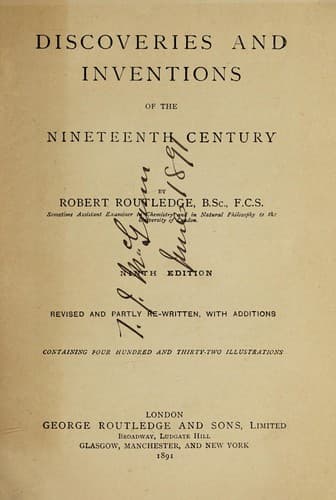
Discoveries and Inventions of the Nineteenth CenturyRoutledge, Robert
History
Discoveries and Inventions of the Nineteenth Century
Routledge, Robert
Inventions -- History -- 19th century
We have now to call attention to a substance which contributes by far
the largest part to the solid crust of our globe. It is called _silica_,
from _silic-_, the Latin word for flint (without case suffix): it is
seen in flint, and very pure in rock crystal, quartz, agate, and
calcedony. It forms the essential part of every kind of sand and
sandstone, and is the principal ingredient of clay, granite, slate,
basalt, and many other minerals. Silica is the oxide of a quasi-metal
called _silicon_, which can be obtained from silica with difficulty, and
only by roundabout processes, presenting itself in different conditions
according to the process used. Silica is an acid oxide, and it readily
unites with most of the basic oxides when heated with them, forming a
class of compounds of different properties which are much modified in
admixtures containing two or more. Very few of these _silicates_ are
soluble in water, most of them are not: they are all fusible at various
temperatures, except silicate of alumina, of which fire-clay is chiefly
constituted. Alumina, it should be stated, is the oxide of the metal
aluminium. The silicates of lime and of magnesia fuse only with great
difficulty; but the silicates of iron and of manganese are easily fused,
and silicate of lead still more so. Glass is a mixture of silicates,
often of lime, soda, and alumina; sometimes of lead and potash mainly;
porcelain and pottery consist chiefly of silicate of alumina with
varying proportions of silicates of iron, of lime, etc.
Public-domain text, read in full here on John Shaqi.
Reviews
Reviews
No reviews yet
Be the first to share your thoughts on this work.
Elsewhere in the archive
Join the Discussion
Join the discussion
Sign in to leave a comment or review.
Sign InorCreate an account