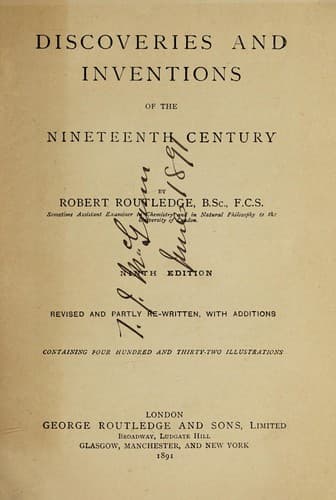
Discoveries and Inventions of the Nineteenth CenturyRoutledge, Robert
History
Discoveries and Inventions of the Nineteenth Century
Routledge, Robert
Inventions -- History -- 19th century
It now remains only to mention two non-metallic elements that are nearly
always present in crude iron, but which the metallurgist strives to
eliminate, as they are in general very injurious to the quality of the
material even when their amount is very small. The first is _sulphur_,
well known as _brimstone_, also as _flowers of sulphur_, a yellow
coloured solid, which burns in the air. The product of the combustion is
an invisible gas of a readily recognized pungent odour: this is an
acid-forming oxide containing equal weights of sulphur and oxygen. There
is another oxide in which the weight of oxygen is one and a half times
that of the sulphur, and this is the radicle of the very active
_sulphuric acid_ or _oil of vitriol_. Sulphur, like oxygen, unites with
most of the other elements, forming compounds called _sulphides_. Of
these the iron compound called _pyrites_ is the best known, and its
occurrence in coal prevents the use of that material as fuel in contact
with iron or other metals. _Phosphorus_ is an element that occurs
naturally only in combination; in its separated state it is a very
inflammable solid. It combines directly with other substances and is
taken up by some fused metals in large quantities. In many cases a very
small proportion of it existing in a metal greatly modifies the
properties of that metal. Phosphorus forms several oxides, and these are
radicles of powerful acids, among which is _phosphoric acid_ that
combines with basic oxides to form _phosphates_.
Public-domain text, read in full here on John Shaqi.
Reviews
Reviews
No reviews yet
Be the first to share your thoughts on this work.
Elsewhere in the archive
Join the Discussion
Join the discussion
Sign in to leave a comment or review.
Sign InorCreate an account