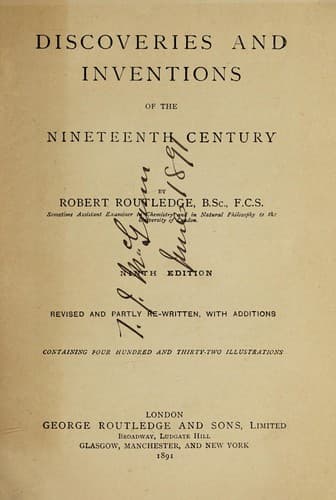
Discoveries and Inventions of the Nineteenth CenturyRoutledge, Robert
History
Discoveries and Inventions of the Nineteenth Century
Routledge, Robert
Inventions -- History -- 19th century
We have now, in the few last paragraphs, set before the reader the
minimum of chemical knowledge that will enable him to follow the
_rationale_ of such processes of the modern treatment of iron and its
ores as we can here give an outline of. Although there are numberless
minerals from which some iron can be extracted, the name of _iron ore_
is confined to such as contain a sufficient amount to make the
extraction commercially profitable, and this requires that the mineral
should be capable of yielding at least one-fifth of its weight. The ores
are very abundant in many parts of the world, and they consist mainly of
_oxides_ and their _hydrates_, or of _carbonate_, or of carbonate mixed
with clay and silicates, sometimes also with coaly matters in addition.
The carbonate iron ores are often mixed with oxides. Each class of ore
is liable to be contaminated with phosphates and with sulphur. The
richest ore is the _magnetic iron ore_, which is found in enormous
masses in Sweden, Russia, and North America. It is an oxide containing
72·41 per cent. of iron. _Red hæmatite_ and _specular ore_ are varieties
of another oxide with 70 per cent. of iron: the former is a very pure
ore when compact. It is found in Lancashire, Cumberland, and South
Wales, and much has been imported from Spain, while America has abundant
supplies near Lake Superior. Specular iron ore forms brilliant
steel-like crystals which show the red colour of hæmatite only when
scratched or powdered. Elba was famous for this ore, which occurs also
in Russia and Sweden, and large deposits are met with in both North and
South America. Brown hæmatite is a hydrate of the former, containing 60
per cent. of iron; it abounds in France and Spain, where some kinds are
associated with a noteworthy quantity of _phosphate_ of iron. _Spathic_
or _sparry iron_ ore is, when pure, a collection of nearly colourless
transparent crystals, consisting of carbonate of iron; it contains about
48 per cent. of iron, and also some of the metal _manganese_, which last
circumstance makes it, as we shall see, particularly suitable for
producing certain kinds of steel—indeed it is sometimes called _steel
ore_. Large beds of it occur in Styria and Carinthia. _Clay iron stone_,
or _clay-band_, has been extensively mined in Britain. It is found
abundantly in Staffordshire, Yorkshire, Derbyshire, and South Wales. It
consists of carbonate of iron intimately mixed with clay. The quantity
of iron in some samples falls as low as 17 per cent., but it rises with
variations to as much as 50 per cent. Much of its importance arises from
the fact of its occurring in beds alternating with layers of coal,
limestone, and clay, so that the same pit is sometimes able to supply
firebricks for building the furnace, fuel for the smelting, and
limestone for the _flux_,—a combination of advantages that for long
enabled iron to be produced in England cheaper than elsewhere. The like
Public-domain text, read in full here on John Shaqi.
Reviews
Reviews
No reviews yet
Be the first to share your thoughts on this work.
Elsewhere in the archive
Join the Discussion
Join the discussion
Sign in to leave a comment or review.
Sign InorCreate an account