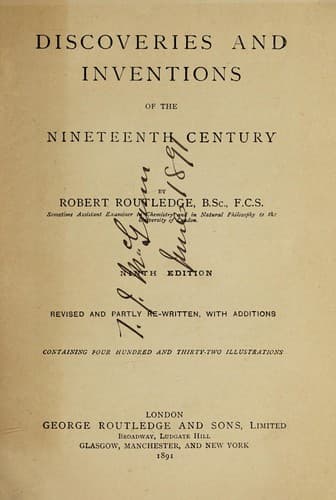
Discoveries and Inventions of the Nineteenth CenturyRoutledge, Robert
History
Discoveries and Inventions of the Nineteenth Century
Routledge, Robert
Inventions -- History -- 19th century
is true of the _blackband ore_, which, in addition to the same
ferruginous composition as the last, contains also so much combustible
or bituminous material that it can be _calcined_ (roasted) without
additional fuel. The deposits of _blackband_ in Lanarkshire and
Ayrshire, which were discovered only in 1801, have given great
industrial importance to the district. Yet another British ore must be
noticed, namely, the _Cleveland ironstone_ of the North Riding of
Yorkshire. This is a carbonate of a grey or bluish colour caused by the
presence of a little iron silicate. It contains also a considerable
amount of phosphorus.
How simple is the operation of obtaining iron from the ore has already
been stated—that it is necessary only to surround lumps of ore by fuel
in a fire urged by a natural or artificial blast, and then to hammer the
mass extracted from the furnace so as to weld together the scattered
particles of the metal, and at the same time squeeze out the associated
slag and cinders, in order to obtain a coherent malleable piece, which
can be reheated in a smith’s fire, and forged into any required form. It
is no wonder therefore that iron was so produced by the ancient Britons;
at any rate Cæsar found them well provided with iron implements and
weapons. No doubt the Romans brought their more advanced skill to the
working of the metal; but in the matter of treating the original ore,
the methods they pursued on an extensive scale in Britain were of the
rude kind already described. Indeed in localities where the Romans were
known to have carried on their operations, the remains of their workings
are almost always found on high ground, so that it may be inferred that
they relied upon the winds to fan their fires, and their operations were
incomplete and wasteful. The most extensive of them appear to have been
in Sussex and Monmouthshire, in which last county there are places where
the ground is in large areas covered by their cinders and refuse, and in
this about 30 or 40 per cent. of iron occurs, so that for some centuries
this material was found capable of being profitably reworked as a source
of the metal. Iron continued to be produced in England during the middle
ages with charcoal for fuel, but its export was forbidden, and whatever
steel was required had to be imported from abroad. Afterwards German
artisans were brought over for making steel, and soon afterwards the
importation of shears, knives, locks, and other articles was prohibited.
The native production of iron continued, and this consumed the forests
so rapidly for the supply of charcoal, that various Acts were passed to
restrain the iron-makers, in order to preserve the timber. In spite of
these, the arts of smelting and working iron advanced apace: bellows
were used for the blast, and then the works were brought down into the
valleys, where water power could be employed to work them. The scarcity
of charcoal fuel caused many attempts to supply its place with pit coal,
Public-domain text, read in full here on John Shaqi.
Reviews
Reviews
No reviews yet
Be the first to share your thoughts on this work.
Elsewhere in the archive
Join the Discussion
Join the discussion
Sign in to leave a comment or review.
Sign InorCreate an account