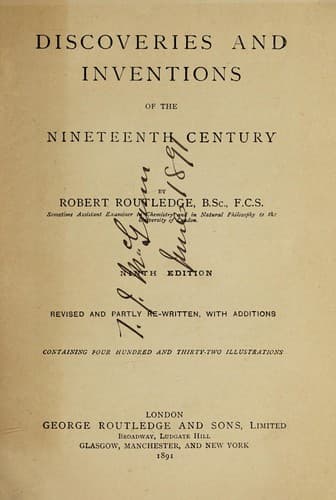
Discoveries and Inventions of the Nineteenth CenturyRoutledge, Robert
History
Discoveries and Inventions of the Nineteenth Century
Routledge, Robert
Inventions -- History -- 19th century
but these met with small success, partly on account of the coal
containing so much sulphur, and partly from the difficulty of obtaining
with it a sufficiently high temperature, especially as the blowing
apparatus was as yet very imperfect. At length, in the first half of the
seventeenth century, the problem was solved by Dud Dudley, whose process
was kept secret, but is believed to have consisted in supplying coal at
the top of a higher furnace, in such a manner that the coal was
converted into _coke_ by the heat of the escaping gases before it
reached the reducing zone of the furnace. This innovation was violently
opposed by the charcoal smelters, who persecuted the inventor in every
way, until their resistance was successful. But before the middle of the
next century coke was regularly used in iron smelting, the process
having been made successful by Darby at Coalbrookdale, and then many new
applications of cast iron came into vogue. Coke being a substance
burning less freely than charcoal, bellows were found inadequate to give
the necessary blast, and were displaced by _blowing cylinders_, actuated
at first by water wheels, but this uncertain and comparatively feeble
source of power was soon superseded by the steam engine, the “fire
engine,” for which, as we have seen, Watt obtained his patent in 1769.
The furnaces were not then all engaged in producing the fusible metal
now called _cast_ or _pig iron_ as are the huge blast furnaces we see at
the present time. Indeed it was much to the disgust of the old iron
smelter that occasionally his product turned out to be of the fusible
kind, unworkable by the hammer, which therefore he regarded as
worthless. At what date _cast iron_ was first used is uncertain; but
probably it was not long before the fourteenth century. The furnaces in
use up to that time were small square walled-in structures only 3 or 4
feet high, and their effect would not greatly exceed that of a smith’s
forge: but as improved blowing apparatus gave more power, they soon
became enlarged into oval or round brick towers from 10 to 15 feet high,
and they, like the small furnaces, could be made to yield either smith
iron or steel by modifying the charge and the manner of applying the
blast; while furnaces of dimensions exceeding a certain limit could no
longer be trusted to turn out malleable metal, but they produced instead
the cruder substance we call white pig iron, and this requires much
subsequent treatment before it is converted into malleable or “merchant
iron.” Nevertheless the demand for cast iron as such, and more
particularly the adoption of improved methods of deriving malleable iron
from it, caused further increase in the size and numbers of blast
furnaces, until in the early part of our century 30 feet was not an
unusual height, the highest one in England in 1830 attaining 40 feet.
The total make of pig iron in England was in that year nearly 700,000
Public-domain text, read in full here on John Shaqi.
Reviews
Reviews
No reviews yet
Be the first to share your thoughts on this work.
Elsewhere in the archive
Join the Discussion
Join the discussion
Sign in to leave a comment or review.
Sign InorCreate an account