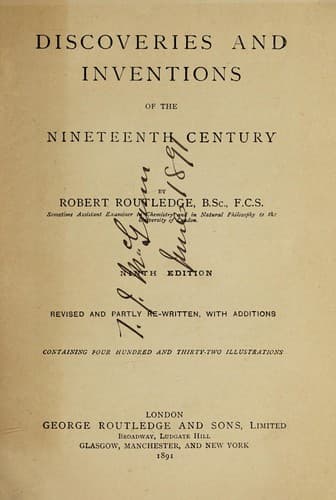
Discoveries and Inventions of the Nineteenth CenturyRoutledge, Robert
History
Discoveries and Inventions of the Nineteenth Century
Routledge, Robert
Inventions -- History -- 19th century
So far from being simply iron, pig contains a large and variable
proportion of other matters amounting often to 10 or 12 per cent.; and
these confer upon it its fusibility. The principal one is carbon, which
is found in the metal partly in the state of chemical combination with
it, and partly in the form of small crystals similar to those of
graphite or plumbago, disseminated through the mass. When there is a
comparatively small proportion of the carbon combined with the iron, the
substance is grey, and it can be filed or drilled or turned in a lathe.
In white cast iron the combined carbon predominates, or is sometimes
accompanied by scarcely any graphitic carbon; it is brittle and so very
hard that a file makes no impression. It fuses at a lower temperature
than the other varieties. A third kind is the _mottled_ cast iron, which
shows a large coarse grain when broken, and distinct points of separate
graphite particles; it is tougher than the others, and therefore when
cannon were made of cast iron this variety was preferred. The following
table giving the percentage composition of four samples of crude cast
iron will show their diversities.
┌─────────────────────────────────┬────────┬────────┬────────┬────────┐
│ │ White.│ White.│Mottled.│ Grey.│
├─────────────────────────────────┼────────┼────────┼────────┼────────┤
│Iron │ 88·81│ 89·304│ 93·29│ 90·376│
│Combined carbon │ 4·94│ 2·457│ 2·78│ 1·021│
│Graphite, or uncombined carbon │ ...│ 0·871│ 1·99│ 2·641│
│Silicon │ 0·75│ 1·124│ 0·71│ 3·061│
│Sulphur │ trace│ 2·516│ trace│ 1·139│
│Phosphorus │ 0·12│ 0·913│ 1·23│ 0·928│
│Manganese │ 5·38│ 2·815│ trace│ 0·834│
└─────────────────────────────────┴────────┴────────┴────────┴────────┘
The reader will observe that the last item in the table above is a
substance that he has not yet made the acquaintance of, namely,
_manganese_. This is a metal which in many of its chemical relations
much resembles iron, and ferruginous ores usually contain a greater or
less proportion of it. Manganese is of great importance in the
manufacture of steel, as we shall presently see; but as a separate metal
it has no application, and is obtainable in the metallic state with much
difficulty. One of its oxides has however very extensive applications in
the chemical arts, and others form acid radicles, which in combination
with potash or soda give rise to useful products. The well-known
“Condy’s fluid” is a solution of one of these.
Public-domain text, read in full here on John Shaqi.
Reviews
Reviews
No reviews yet
Be the first to share your thoughts on this work.
Elsewhere in the archive
Join the Discussion
Join the discussion
Sign in to leave a comment or review.
Sign InorCreate an account