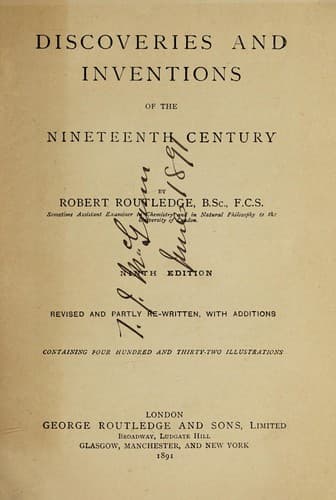
Discoveries and Inventions of the Nineteenth CenturyRoutledge, Robert
History
Discoveries and Inventions of the Nineteenth Century
Routledge, Robert
Inventions -- History -- 19th century
between iron rollers (these we shall presently describe), by which it is
shaped into a bar. The bars are afterwards cut into lengths, reheated
without contact of fuel, again hammered or re-rolled; and this process
is several times repeated when the best product is required. During the
first treatment of the blooms, and also in the subsequent hammering or
rolling, the oxygen of the atmosphere acts on the surface of the glowing
metal, so as to cover it with thin scales of oxide, and these, carried
into the interior of the mass, will give up their oxygen to any residual
silicon, carbon, etc., producing a little more slag, carbonic oxide,
phosphate of iron, etc., which by the pressure of the hammers or rolls
are ultimately forced out of the metal. It will be observed that in
producing the pig iron the chemical action is the separation of oxygen
from the metal, while conversely an oxidizing action is set up in the
finery and subsequent treatment, in order to burn off the foreign
ingredients. But this cannot be done without at the same time
re-oxidizing some of the iron itself, of which therefore there is always
a considerable loss, by its formation into slag (silicate), cinder,
foundry scale (oxide), etc. The quantity of iron lost depends of course
on many conditions, such as the care exercised in the operations, but it
occurs in all the processes that have been devised for the conversion in
question, even in the most modern: its amount may be taken to range
between 10 and 20 per cent. The reader is requested to bear in mind the
nature of the chemical actions that have just been described, for in
even the most recently invented processes the principle is the same in
nature and effect. So completely can the foreign elements be eliminated
by this, or some analogous process, such as we shall presently mention,
that the finest Swedish bar iron contains more than 99½ per cent. of the
metal, and in some cases only a very little carbon and a mere trace of
phosphorus remain, amounting together to less than 1 part in 2000. Such
metal is made from very pure ore, containing no sulphur and scarcely any
phosphorus, while charcoal is the fuel used in all the operations. As
already mentioned, the objection to the use of coke is the sulphur,
phosphates, and siliceous matters it contains. Toward the close of the
eighteenth century an invention came into use which obviated the
disadvantages of the cheaper fuel for converting crude iron. This was
the puddling furnace, brought into use after much experimenting by Henry
Cort in 1784. In it the pig iron is fused in a _reverberatory furnace_,
the form of which will be understood from Fig. 19, which is a diagram
showing such a furnace in section, where _f_ is the fire, _a_ an
aperture at which the fuel is introduced, _p_ the ash pit, _b_ is a low
wall of refractory material called the “bridge,” over which the flame
passes, and is by the low arched roof reflected or _reverberated_
Public-domain text, read in full here on John Shaqi.
Reviews
Reviews
No reviews yet
Be the first to share your thoughts on this work.
Elsewhere in the archive
Join the Discussion
Join the discussion
Sign in to leave a comment or review.
Sign InorCreate an account