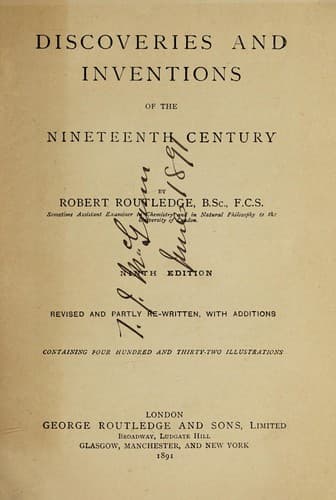
Discoveries and Inventions of the Nineteenth CenturyRoutledge, Robert
History
Discoveries and Inventions of the Nineteenth Century
Routledge, Robert
Inventions -- History -- 19th century
downwards upon the charge, _c_, which is laid on a _hearth_, or iron
floor, having spaces below it where air circulates in order to prevent
it becoming too hot. In Cort’s original arrangement the bed of the
hearth was formed of sand, which gave rise to much inconvenience by
producing a quantity of the very fusible silicate of iron, that speedily
attacked the masonry of the furnace, and therefore a very important
improvement was devised some years later by S. B. Rogers, who made the
bed of his furnace of a layer of oxide of iron, spread on a cast iron
plate 1½ inches thick. In later times it has become usual to cover the
iron hearth with certain other refractory mixtures varied according to
circumstances, of oxide, ore, cinder, lime, etc. There is one of these
mixtures significantly designated “_bull-dog_” by the workmen. We may
mention here that it has, in more recent times, when very high
temperatures are obtainable, been found unnecessary to cause even the
flame to come into contact with the substances on the hearth, inasmuch
as the heat radiated from the flame and the intensely heated roof of the
furnace suffices, so that in consequence of this the roofs are now
constructed nearly flat. In the puddling furnace the melted metal is
constantly stirred, and no little skill is required to regulate the fire
by the damper on the chimney, and to admit the proper amount of air to
mix with the flame. The pig iron softens and melts gradually, until at
length it becomes perfectly liquid, at which stage it swells up and
appears to boil owing to the escape of carbonic oxide in numerous jets,
which burn with the characteristic pale blue flame. The puddler then
briskly stirs the mass to cause more complete oxidation of the carbon,
silicon, etc., by bringing the superficially formed oxide of iron into
the interior. As the iron loses its carbon, it assumes much the texture
of porridge, consisting of pasty lumps of malleable iron implexed with
the liquid slag (silicate of iron, etc.) which drips from the spongy
balls as the puddler collects them at the end of his stirring rod, as in
the finery operation. The next thing is to run the mass immediately
between powerful rolls (puddling rolls) by which the slag is squeezed
out, as before, and finally through the _finishing rolls_ that shape it
into bars or plates.
When a comparatively impure pig iron is used or when a better quality of
malleable metal is desired, the crude iron is submitted to a preliminary
treatment before puddling. This treatment, by a technical distinction,
called _refinery_, is practically identical with the _finery_ process
already described, except that instead of being collected into blooms,
the fluid metal is run out to form a layer 2 or 3 inches thick, and
this, before becoming quite solid, is suddenly cooled by having water
thrown over it, the result being a white, hard, brittle mass, which
broken into pieces is ready for the puddling furnace.
Public-domain text, read in full here on John Shaqi.
Reviews
Reviews
No reviews yet
Be the first to share your thoughts on this work.
Elsewhere in the archive
Join the Discussion
Join the discussion
Sign in to leave a comment or review.
Sign InorCreate an account