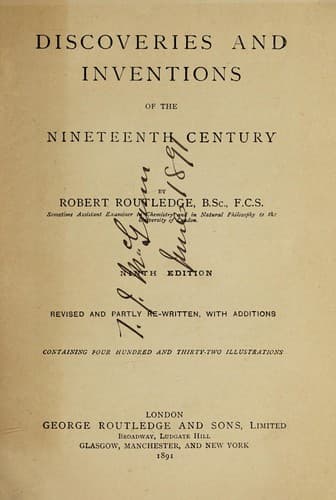
Discoveries and Inventions of the Nineteenth CenturyRoutledge, Robert
History
Discoveries and Inventions of the Nineteenth Century
Routledge, Robert
Inventions -- History -- 19th century
temperature that produces the greatest softening, and the properties of
the tempered steel will depend upon the precise degree to which the
metal has been reheated. For example, if the product be required for
making into sword blades, or watch-springs, and to possess much
elasticity, the proper temperature is between 550° F. and 570° F.; but
if the steel is to be suitable for saws the temperature must range
within a few degrees of 600° F., according to the fineness of the tool
intended; a lower temperature would give a metal too hard for them to be
sharpened with a file. On the other hand, sharp cutting instruments and
tools for working metals are obtained hard by tempering at lower degrees
than springs. In practice the index of the temperature is taken from the
colour of the film of oxide that gradually forms on a polished surface
of the metal as the heat is raised, and begins by a very pale yellow (at
430° F.), passing through deeper shades into brown, then through purple
into deep blue (at 570° F.), etc. The reader will now see why watch and
clock springs have their deep blue colour, and he can observe for
himself the whole series of colours by very gradually heating a piece of
polished steel over a small flame.
If we compare the chemical composition of wrought iron and of cast iron
with that of steel as regards the content of carbon, we see at once that
steel holds an intermediate position, so that if in the puddling furnace
we could arrest the decarbonization at a certain point we should obtain
steel; or if, on the other hand, we could put back into chemical
combination with the decarbonized wrought iron a due percentage of
carbon we should in that way also obtain steel. And it will be observed
that the oldest primitive furnaces could not have failed sometimes to
have produced steel as the net or final result of such actions. In fact,
steel always has been and still is produced on one or other of these two
principles, applied in divers ways, but severally and distinctly
directed to that end. Of the many more or less modified processes of
steel-making that have been in use, we need here but briefly mention a
few which were _the_ processes of the first sixty years of our century,
and are to a considerable extent still in operation, although eclipsed
in importance by two other processes that, since the date referred to,
have been supplying the metal in enormously increased quantities, and
which will have to be particularly described.
Public-domain text, read in full here on John Shaqi.
Reviews
Reviews
No reviews yet
Be the first to share your thoughts on this work.
Elsewhere in the archive
Join the Discussion
Join the discussion
Sign in to leave a comment or review.
Sign InorCreate an account