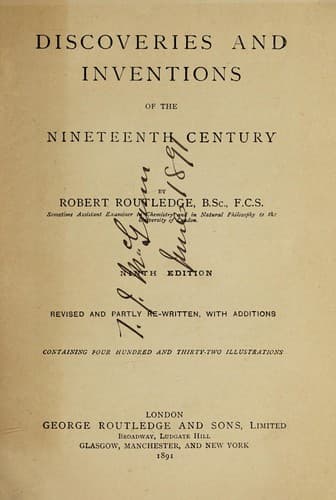
Discoveries and Inventions of the Nineteenth CenturyRoutledge, Robert
History
Discoveries and Inventions of the Nineteenth Century
Routledge, Robert
Inventions -- History -- 19th century
Another method of dealing with the blister steel is to charge crucibles
or pots having covers with 50 or 100 lbs. weight of the broken-up bars,
and subject the crucibles to a strong heat in a reverberatory furnace,
when the metal melts, and at the proper moment the contents of a great
number of pots are almost simultaneously poured into a mould to form an
_ingot_. The result is a very uniform steel of the finest texture, known
and highly esteemed as _cast steel_ or _crucible steel_. This steel is
much more fusible than iron, but less so than cast iron.
The production of steel by arresting at a certain stage the
decarbonizing of cast iron in the puddling furnace requires much
experience on the part of the workman, who has to learn when the desired
point has been reached by certain indications, such as the appearance of
the flame, or by the examination of a small sample of the fluid metal
withdrawn and rapidly cooled. Various additions to the charge in
definite proportions are generally made, such as scales of iron oxide,
or a quantity of an oxide ore (hæmatite, etc.) or other materials, the
most essential for a good product consisting of a little manganese in
some form. The result is _puddled steel_; and this, like blister steel,
can be converted into cast steel by fusion in crucibles, running into
ingot moulds, and subsequent treatment by hammering, pressing, rolling,
etc. In 1864 puddled steel was described as an article of great
commercial importance, but this it soon lost by the introduction of
simpler, cheaper, and more reliable processes. The methods and
improvements proposed for the production of steel have been exceedingly
numerous, as is shown by the records of the English Patent Office alone,
which contain up to the end of 1856 specifications of ninety-two patents
for different steel-manufacturing processes, while from 1857 to 1865,
the epoch-marking period of steel making, seventy-four more patents were
obtained for this purpose. It would be quite beyond our limits to make
special reference to these, and to the numerous patents which have since
been granted, but there is one of great importance in steel-making which
must be mentioned, and that is the patent for the employment in the
cementation process of carbide of manganese, taken out by J. M. Heath in
1839. This made England almost independent of the former large
importations of Swedish and Russian iron, and it caused an immediate
reduction of £40 in the price per ton of good steel, effecting a saving
which up to 1855 is calculated at not less than £2,000,000. Heath was
one of those who fail to benefit by their inventions, for his was boldly
appropriated by another person who took advantage of a verbal flaw in
the specification, and Heath did not obtain any redress from the law
courts until, after ten years’ litigation, a majority of Exchequer
judges reversed all the previous decisions against him (1853). In the
meantime the man had died, but as the patent was about to expire his
Public-domain text, read in full here on John Shaqi.
Reviews
Reviews
No reviews yet
Be the first to share your thoughts on this work.
Elsewhere in the archive
Join the Discussion
Join the discussion
Sign in to leave a comment or review.
Sign InorCreate an account