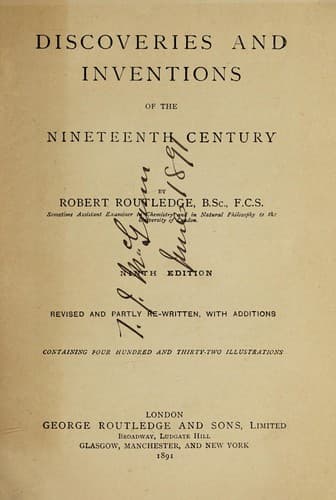
Discoveries and Inventions of the Nineteenth CenturyRoutledge, Robert
History
Discoveries and Inventions of the Nineteenth Century
Routledge, Robert
Inventions -- History -- 19th century
“I have before mentioned that after the boil has taken place a steady
and powerful flame succeeds, which continues without any change for
about ten or twelve minutes, when it rapidly falls off. As soon as this
diminution of flame is apparent the workman will know that the process
is completed, and that the crude iron has been converted into pure
malleable iron, which he will form into ingots of any suitable size and
shape by simply opening the tap-hole of the converting vessel and
allowing the fluid malleable iron to flow into the iron ingot moulds
placed there to receive it. The masses of iron thus formed will be free
from any admixture of cinder, oxide, or other extraneous matters, and
will be far more pure and in a forwarder state of manufacture than a
pile formed of ordinary puddle bars. And thus it will be seen that by a
single process, requiring no manipulation or particular skill, and with
only one workman, from three to five tons of crude iron pass into the
condition of several piles of malleable iron in from thirty to
thirty-five minutes, with the expenditure of about a third part the
blast now used in a finery furnace, with an equal charge of iron, and
with the consumption of no other fuel than is contained in the crude
iron.
“To those who are best acquainted with the nature of fluid iron, it may
be a matter of surprise that a blast of cold air forced into melted
crude iron is capable of raising its temperature to such a degree as to
retain it in a perfect state of fluidity after it has lost all its
carbon and is in the condition of malleable iron, which, in the highest
heat of our forges, only becomes softened into a pasty mass. But such is
the excessive temperature that I am enabled to arrive at with a properly
shaped converting vessel and a judicious distribution of the blast, that
I am enabled not only to retain the fluidity of the metal, but to create
so much surplus heat as to remelt all the crop-ends, ingot-runners, and
other scrap that is made throughout the process, and thus bring them,
without labour or fuel, into ingots of a quality equal to the rest of
the charge of new metal....
Public-domain text, read in full here on John Shaqi.
Reviews
Reviews
No reviews yet
Be the first to share your thoughts on this work.
Elsewhere in the archive
Join the Discussion
Join the discussion
Sign in to leave a comment or review.
Sign InorCreate an account