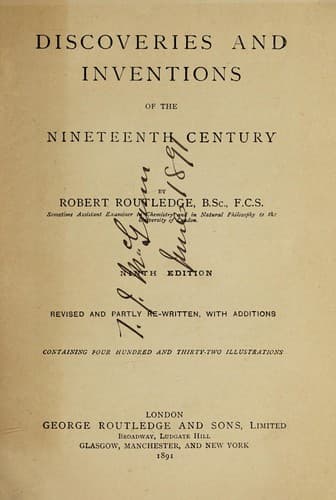
Discoveries and Inventions of the Nineteenth CenturyRoutledge, Robert
History
Discoveries and Inventions of the Nineteenth Century
Routledge, Robert
Inventions -- History -- 19th century
“To persons conversant with the manufacture of iron, it will be at once
apparent that the ingots of the malleable metal which I have described
will have no hard or steely parts, such as are found in puddled iron,
requiring a great amount of rolling to blend them with the general mass,
nor will such ingots require an excess of rolling to expel cinder from
the interior of the mass, since none can exist in the ingot, which is
pure and perfectly homogeneous throughout, and hence requires only as
much rolling as is necessary for the development of fibre; it therefore
follows that, instead of forming a merchant bar, or rail, by the union
of a number of separate pieces welded together, it will be far more
simple and less expensive to make several bars or rails from a single
ingot. Doubtless this would have been done long ago had not the whole
process been limited by the size of the ball which the puddler could
make.
“The facility which the new process affords of making large masses will
enable the manufacturer to produce bars that, in the old mode of
working, it was impossible to obtain; while at the same time it admits
of the use of more powerful machinery, whereby a great deal of labour
will be saved and the process be greatly expedited.... I wish to call
the attention of the meeting to some of the peculiarities which
distinguish cast steel from all other forms of iron, viz., the perfectly
homogeneous character of the metal, the entire absence of sand-cracks or
flaws, and its greater cohesive force and elasticity, as compared with
the blister steel from which it is made,—qualities which it derives
solely from its fusion and formation into ingots, all of which
properties malleable iron acquires in like manner by its fusion and
formation into ingots in the new process; nor must it be forgotten that
no amount of rolling will give the blister steel, although formed of
rolled bars, the same homogeneous character that cast steel acquires by
a mere extension of the ingot to some ten or twelve times its original
length....
Public-domain text, read in full here on John Shaqi.
Reviews
Reviews
No reviews yet
Be the first to share your thoughts on this work.
Elsewhere in the archive
Join the Discussion
Join the discussion
Sign in to leave a comment or review.
Sign InorCreate an account