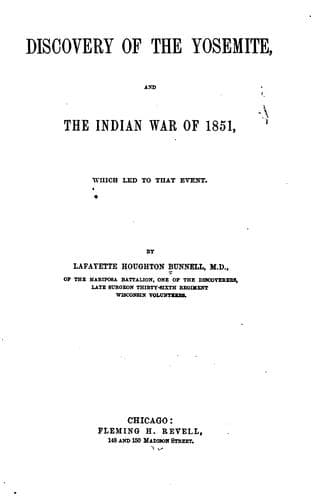
Discovery of the Yosemite, and the Indian War of 1851, Which Led to That EventBunnell, Lafayette Houghton
History
Discovery of the Yosemite, and the Indian War of 1851, Which Led to That Event
Bunnell, Lafayette Houghton
Indians of North America -- California; Pacific Coast Indians, Wars with, 1847-1865; Yosemite Valley (Calif.)
SIR: Your Excellency has doubtlessly been informed by Mr. Johnston and
others, of repeated and aggravated depredations of the Indians in this
part of the State. Their more recent outrages you are probably not
aware of. Since the departure of Mr. Johnston, the Indian agent, they
have killed a portion of the citizens on the head of the San Joaquin
river, driven the balance off, taken away all movable property, and
destroyed all they could not take away. They have invariably murdered
and robbed all the small parties they fell in with between here and
the San Joaquin. News came here last night that seventy-two men were
killed on Rattlesnake Creek; several men have been killed in Bear
Valley. The Fine Gold Gulch has been deserted, and the men came in here
yesterday. Nearly all the mules and horses in this part of the State
have been stolen, both from the mines and the ranches. And I now, in
the name of the people of this part of the State, and for the good of
our country, appeal to your Excellency for assistance.
In order to show your Excellency that the people have done all that
they can do to suppress these things, to secure quiet and safety in the
possession of our property and lives, I will make a brief statement of
what has been done here.
After the massacres on the Fresno, San Joaquin, etc., we endeavored
to raise a volunteer company to drive the Indians back, if not to
take them or force them into measures. The different squads from the
various places rendezvoused not far from this place on Monday, 6th, and
numbered but seventy-four men. A company was formed, and I was elected
captain; J. W. Riley, first lieutenant; E. Skeane, second lieutenant.
We had but eight day’s provisions, and not enough animals to pack our
provisions and blankets, as it should have been done. We, however,
marched, and on the following day struck a large trail of horses that
had been stolen by the Indians. I sent forward James D. Savage with
a small spy force, and I followed the trail with my company. About
two o’clock in the morning, Savage came in and reported the village
near, as he had heard the Indians singing. Here I halted, left a
small guard with my animals, and went forward with the balance of my
men. We reached the village just before day, and at dawn, but before
there was light enough to see how to fire our rifles with accuracy, we
were discovered by their sentinel. When I saw that he had seen us, I
ordered a charge on the village (this had been reconnoitered by Savage
and myself). The Indian sentinel and my company got to the village
at the same time, he yelling to give the alarm. I ordered them to
surrender, some of them ran off, some seemed disposed to surrender, but
others fired on us; we fired and charged into the village. Their ground
had been selected on account of the advantages it possessed in their
mode of warfare. They numbered about four hundred, and fought us three
hours and a half.
Public-domain text, read in full here on John Shaqi.
Discovery of the Yosemite, and the Indian War of 1851, Which Led to That Event — John Shaqi
Reviews
Reviews
No reviews yet
Be the first to share your thoughts on this work.
Join the Discussion
Join the discussion
Sign in to leave a comment or review.
Sign InorCreate an account