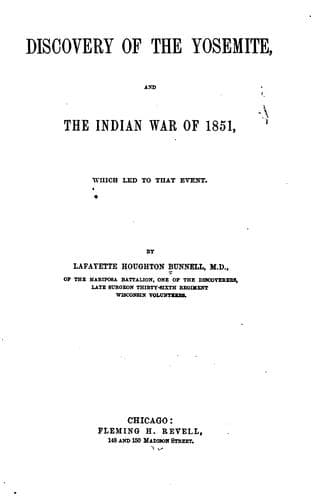
Discovery of the Yosemite, and the Indian War of 1851, Which Led to That Event — John Shaqi
Discovery of the Yosemite, and the Indian War of 1851, Which Led to That EventBunnell, Lafayette Houghton
History
Discovery of the Yosemite, and the Indian War of 1851, Which Led to That Event
Bunnell, Lafayette Houghton
Indians of North America -- California; Pacific Coast Indians, Wars with, 1847-1865; Yosemite Valley (Calif.)
It is only required of me to say here that re-inforced by such leaders
of men as Kuykendall, Boling, Chandler and Doss, there was no delay,
and the campaign was completed at “Battle Mountain,” a water shed of
the San Joaquin.
I now introduce a letter of great value, to me, as it fixes the date
of the first battle, and disproves assertions made in the _Century_
Magazine:
HART’S RANCH, CALIFORNIA, JANUARY 16th, 1851.
MY DEAR FATHER: When I wrote my last letter to you I had fully
determined to take a Ranch near Pacheco’s Pass, as I informed you, but
before three days had passed the report of Jim Kennedy’s murder on the
Fresno was confirmed, and I started for the mountains in pursuit of
the Indians who were committing depredations all through the country
and had sworn to kill every white man in it. Four hundred men had
promised to go, but at the appointed time only seventy-seven made their
appearance. With these we started under the command of Major Burney,
Sheriff of Mariposa County, guided by Mr. Jas. D. Savage, who is
without doubt the best man in the world for hunting them out.
From his long acquaintance with the Indians, Mr. Savage has learned
their ways so thoroughly that they cannot deceive him. He has been one
of their greatest chiefs, and speaks their language as well as they can
themselves. No dog can follow a trail like he can. No horse endure half
so much. He sleeps but little, can go days without food, and can run a
hundred miles in a day and night over the mountains and then sit and
laugh for hours over a camp-fire as fresh and lively as if he had just
been taking a little walk for exercise.
With him for a guide we felt little fear of not being able to find them.
On Friday morning about ten o’clock, our camp again moved forward
and kept traveling until one that night, when “halt! we are on the
Indians,” passed in a whisper down the line. Every heart beat quicker
as we silently unsaddled our animals and tied them to the bushes around
us. Commands were given in whispers and we were formed in a line. Sixty
were chosen for the expedition, the balance remaining behind in charge
of camp.
Savage said the Indians were about six miles off; that they were
engaged in a feast. He pointed out their fires, could hear them sing
and could smell them, but his eyes were the only ones that could see;
his ears alone could hear, and his nose smell anything unusual. Still,
there was such confidence placed in him that not one doubted for an
instant that everything was as he said.
About two o’clock we started in Indian file, as still as it was
possible for sixty men to move in the dark, for the moon had set. For
three long hours did we walk slowly and cautiously over the rocks and
bushes, through the deepest ravines and up steep and ragged mountain,
until within a half mile of the enemy.
Public-domain text, read in full here on John Shaqi.
Reviews
Reviews
No reviews yet
Be the first to share your thoughts on this work.
Join the Discussion
Join the discussion
Sign in to leave a comment or review.
Sign InorCreate an account