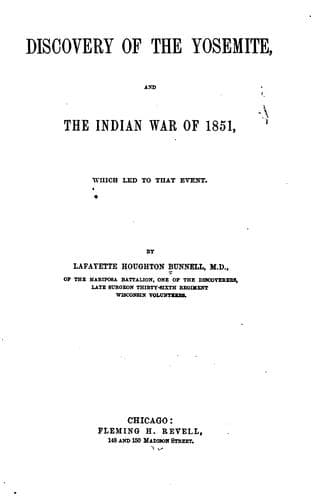
Discovery of the Yosemite, and the Indian War of 1851, Which Led to That EventBunnell, Lafayette Houghton
History
Discovery of the Yosemite, and the Indian War of 1851, Which Led to That Event
Bunnell, Lafayette Houghton
Indians of North America -- California; Pacific Coast Indians, Wars with, 1847-1865; Yosemite Valley (Calif.)
Here every one took off his boots, when we again pushed forward to
about two hundred yards from the camp. Another halt was called to wait
for daylight, while Savage went forward to reconnoitre. He succeeded
in getting within ten paces of the Rancharia, and listened to a
conversation among them in which his name was frequently mentioned.
He found that it was a town of the Kee-chees, but that there were
about one hundred and fifty of the Chow-chil-la warriors with them and
several of the Chu-chan-ces. Had he found only the Kee-chees as he
expected, we were to surround the Rancharia and take all prisoners,
but the presence of so many Chow-chil-las, the most warlike tribe in
California, made a change of plan necessary.
Daylight by this time began to appear. We had been lying in our
stocking-feet on the ground on the top of a mountain within a few paces
of the snow for more than an hour, almost frozen by the intense cold,
not daring to move or speak a word.
It was not yet light enough to see the sight of our rifles, when an
Indian’s head was seen rising on the hill before us. For a moment his
eyes wandered, then rested on us, and with a yell like a Coyote he
turned for the Rancharia. Never did I hear before such an infernal
howling, whooping and yelling, as saluted us then from the throats
of about six hundred savages, as they rushed down the hill into the
gim-o-sell bushes below.
Our huzzahs could, however, hardly have sounded more pleasant to them,
as when finding we were discovered, we charged on their town. Fifty
rifles cracked almost instantaneously; a dozen Indians lay groaning
before their huts, and many supposed we had undisturbed possession.
Our firing had ceased and we were looking around for plunder, when
a rifle fired from the bushes below, struck a young Texan, Charley
Huston, standing by my side. He fell with a single groan, and we all
supposed him dead. My first impression was that I was shot, for I
plainly heard the ball strike and almost felt it. This was a surprise
that almost whipped us, for not knowing that the Indians had fire-arms,
we were only expecting arrows. Before that shot was fired, I had always
entertained the idea that I could run about as fast as common men (and
I was one of the first in the charge), but by the time I had collected
my wandering senses, I was nearly alone; the majority of the party some
thirty paces ahead, and running as if they never intended to stop.
Captain Burney and Mr. Savage were on top of the hill using every
exertion to make the company halt and form. He had partly succeeded,
when a pistol ball struck a man in the face, he fell, but raising
himself up said, “if we stay here we will be all shot” and a break was
made for the trees.
Still some few remained in rank and others slowly answered to the
orders to form, when our Second Lieutenant fell mortally wounded. He
was carried off, and every man took his tree.
Public-domain text, read in full here on John Shaqi.
Reviews
Reviews
No reviews yet
Be the first to share your thoughts on this work.
Join the Discussion
Join the discussion
Sign in to leave a comment or review.
Sign InorCreate an account