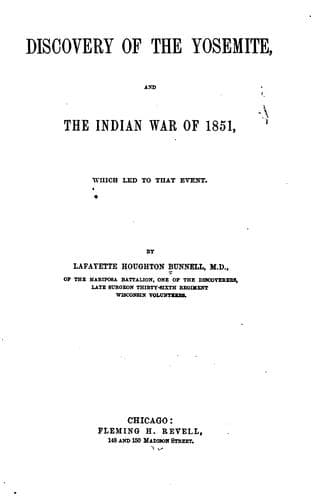
Discovery of the Yosemite, and the Indian War of 1851, Which Led to That EventBunnell, Lafayette Houghton
History
Discovery of the Yosemite, and the Indian War of 1851, Which Led to That Event
Bunnell, Lafayette Houghton
Indians of North America -- California; Pacific Coast Indians, Wars with, 1847-1865; Yosemite Valley (Calif.)
No peace messengers came in from the mountain Indians, who continued
to annoy the settlers with their depredations, thieving from the
miner’s camps, and stealing horses and mules from the ranches. While
we were awaiting the action of the commissioners, we lost some horses
and mules, which were stolen from the vicinity of our camp. After
the commissioners had decided upon the measures to be adopted, our
battalion was ordered into line and we were then officially informed
by Col. Johnson, that our operations as a military organization, would
henceforth be under the direction of the United States Commissioners.
That by their order we were now assigned to the duty of subduing such
Indian tribes as could not otherwise be induced to make treaties
with them, and at once cease hostilities and depredations. “Your
officers will make all reports to the commissioners. Your orders and
instructions will hereafter be issued by them.” The colonel then
complimented the soldierly appearance of the battalion (very customary
in later years) and then said: “While I do not hesitate to denounce
the Indians for the murders and robberies committed by them, we should
not forget that there may perhaps be circumstances which, if taken
into consideration, might to some extent excuse their hostility to
the whites. They probably feel that they themselves are the aggrieved
party, looking upon us as trespassers upon their territory, invaders of
their country, and seeking to dispossess them of their homes. It may
be, they class us with the Spanish invaders of Mexico and California,
whose cruelties in civilizing and christianizing them are still
traditionally fresh in their memories,” etc. In conclusion the colonel
said: “As I am about to leave, I will now bid you ‘good bye,’ with
the hope that your actions will be in harmony with the wishes of the
commissioners, and that in the performance of your duties, you will in
all cases observe mercy where severity is not justly demanded.”
Colonel Johnson gave us a very excellent little speech; but at that
time we were not fully impressed with the justness of the remarks which
had been made from kindness of heart and sincerely humane feelings.
Many of us had lost--some heavily--by the depredations of the Indians.
Friends and relatives had been victims of their atrocities. Murders and
robberies had been committed without provocations then discernible to
us. Many of us would then have been willing to adopt the methods of the
old Spanish missionaries, who, it was said, sometimes brought in their
converts with the lasso. However, these orders and the speech from Col.
Johnson were received with cheers by the more impatient and impulsive
of the volunteers, who preferred active service to the comparative
quiet of the camp.
Public-domain text, read in full here on John Shaqi.
Reviews
Reviews
No reviews yet
Be the first to share your thoughts on this work.
Join the Discussion
Join the discussion
Sign in to leave a comment or review.
Sign InorCreate an account