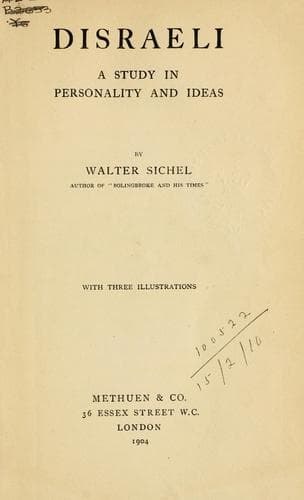
Disraeli: A Study in Personality and IdeasSichel, Walter
History
Disraeli: A Study in Personality and Ideas
Sichel, Walter
Disraeli, Benjamin, 1804-1881
human and national instincts, their theories were as irrefragable as
those of our modern bimetallists, and of those ancient economists on
whose doctrines they rested. But their lasting usefulness depended
on the final achievement of a cosmopolitan confederation. Disraeli
presaged with weighty reasons, scouted when they were detailed, that
other nations would never fall into the scheme; he analysed the
special conditions of France, Germany, and America. He also foretold,
concerning corn, in common with all articles of certain and practically
unlimited demand (as cotton and tea, for examples), that “the moment
you have a settled market, in exact proportion to the demand, prices
will fall. This is the inevitable rule.” He pressed further the grave
peril, hardly yet realised, of England’s dependence on foreign supplies
in time of war. But beyond all, he emphasised the social dangers--the
misery for individuals and for classes. In this precipitate measure
towards a material class-millennium, he discerned a large element
of possible denationalisation, a displacement of labour which must
unavoidably deluge the unwieldy towns, and which would to some extent
relax the fibre of the nation and weaken its very means of defence,
the replacement of excellence by cheapness, and of national welfare
by wealth, the substitution for the landed interest which ought to
preponderate though never to predominate, not, as seemed for the
moment, by a high-toned class of responsible manufacturers, but
eventually by an overwhelming clique of irresponsible capitalists
with self-interests fluid as their portable property; the decrease
of the national, the natural sway of large landowners inheriting a
representative sense of accountability to tenants and dependants; a
probably great fall in agriculture and its profits, prices and wages;
the waste on a large scale and the depopulation of the soil itself; the
special aggravation of ruinous elements in Ireland; an ultimate decay,
when foreign competition should develop, of that very manufacturing
interest the system was protested to advantage and intended to protect;
for he divined already in the ’forties that to fight hostile tariffs
with “free imports” could only benefit England while continental
manufacturers were in comparative infancy.
Public-domain text, read in full here on John Shaqi.
Reviews
Reviews
No reviews yet
Be the first to share your thoughts on this work.
Elsewhere in the archive
Join the Discussion
Join the discussion
Sign in to leave a comment or review.
Sign InorCreate an account