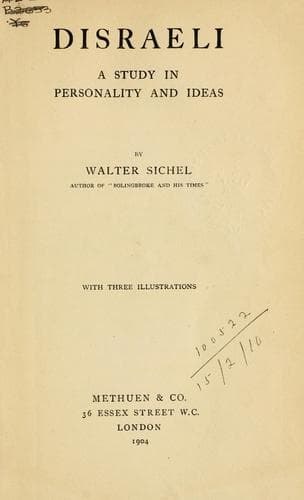
Disraeli: A Study in Personality and IdeasSichel, Walter
History
Disraeli: A Study in Personality and Ideas
Sichel, Walter
Disraeli, Benjamin, 1804-1881
Above all things Disraeli was a personality. Personality is independent
of training, except in the rare cases where education accords with
predisposition. It is the will. And in authorship, when expression
chimes with intention, it is the style. Personality is the clue to
history, for events proceed from character, more than character from
events. Commenting on the adoption of the “Charter” by non-chartists
groaning under the injustice of industrial slavery, Disraeli observes
most truly: “... But all this had been brought about, as most of the
great events of history, by the unexpected and unobserved influence
of individual character.” Personality is the salt of politics; it is
the spirit of our party system; and woe betide every era in England
when figure-heads replace head-figures. It is an atmosphere enchanting
the landscape. “... It is the personal that interests mankind, that
fires their imagination and wins their hearts. A cause is a great
abstraction, and fit only for students: embodied in a party, it
stirs men to action; but place at the head of that party a leader
who can inspire enthusiasm, he commands the world....” Association,
groups, co-operative principles, these are the mechanisms invented
by the brain, and guided by the hand of individuality, the fuel that
individuality gathers and enkindles. Without it they remain dead
lumber, and can never of themselves prove originative forces. What
men crave is, once more in Disraeli’s parlance, “... A primordial and
creative mind; one that will say to his fellows, ‘Behold, God has
given me thought, I have discovered truth, and you _shall_ believe.’”
Personality is the contradiction of the mechanical and of the dead
level; it is the soul of influence. How depressing is the reverse side
of the medal!--“Duncan Macmorrogh” (the utilitarian in _The Young
Duke_), “cut up the Creation and got a name. His attack upon mountains
was most violent, and proved, by its personality that he had come
from the lowlands. He demonstrated the inability of all elevation, and
declared that the Andes were the aristocracy of the globe. Rivers he
rather patronised, but flowers he quite pulled to pieces, and proved
them to be the most useless of existences.... He informed us that
we were quite wrong in supposing ourselves to be the miracle of the
Creation. On the contrary, he avowed that already there were various
pieces of machinery of far more importance than man; and he had no
doubt in time that a superior race would arise, got by a steam-engine
on a spinning-jenny....”
Public-domain text, read in full here on John Shaqi.
Reviews
Reviews
No reviews yet
Be the first to share your thoughts on this work.
Join the Discussion
Join the discussion
Sign in to leave a comment or review.
Sign InorCreate an account