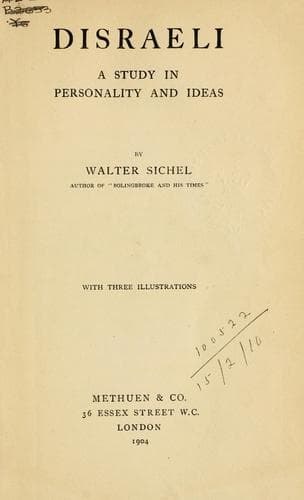
Disraeli: A Study in Personality and IdeasSichel, Walter
History
Disraeli: A Study in Personality and Ideas
Sichel, Walter
Disraeli, Benjamin, 1804-1881
To impress his ideas through his will on his generation, was Disraeli’s
ruling purpose from the first; but to attain the position which would
entitle him to do so he never regarded as more than a ladder towards
his main ambition. Ambition[5] spurred him from the first. But, as
the present Duke of Devonshire generously owned in the heat of party
contest, Disraeli was never prompted by mean or unworthy motives;
and--added the speaker--it would be the merest cant to pretend that
honourable and honest ambition is not a main incitement to public life.
At the outset he was convinced of a mission, and the visions over which
he had long brooded in silent solitude became realised in the world of
action. Both reverie and energy alternated even in his boyish being. “I
fully believed myself the object of an omnipotent Destiny over which
I had no control”--and yet “Destiny bears us to our lot, and Destiny
is perhaps our own will.” “... There arose in my mind a desire to
create things beautiful as that golden star;” and yet “... Nor could
I conceive that anything could tempt me from my solitude ... but the
strong conviction that the fortunes of my race depended on my effort,
or that I could materially forward that great amelioration, ... in the
practicability of which I devoutly believe.” As a boy he dreamed of
“shaking thrones and founding empires;” and yet, he felt that he must
not “pass” his “days like a ghost gliding in a vision.” These are
among the echoes and glimpses afforded by his earliest fiction of his
earliest self, and to this topic I shall recur in my last chapter. I
mention them here for a material reason. In treating his thoughts we
must distinguish between those notions which merely concern success
or career, and those ideas which assured victory was to achieve.
Nor should we omit the very vital distinction between personality
and egotism, for confusion in this regard constantly obscures our
estimates. Individuality with the forces that make for it is not
“individualism;” yet the two are often confused.
The essential egotist is a sort of buccaneer. He roams the seas to
rifle cargoes, and his conquests are the spoils of a freebooter.
He seeks to exploit society for his own benefit--to burn down his
neighbour’s roof-tree that he may boil his egg. He gives nothing
that he can keep, and takes all he can grasp by whatever methods may
advantage him. He leaves the world poorer when he goes, and as he
leaves it, he wishes it. In Cowper’s words--
“Cruel is all he does. ’Tis quenchless thirst
Of ruinous ebriety that prompts
His every action, and imbrutes the man.”
Public-domain text, read in full here on John Shaqi.
Reviews
Reviews
No reviews yet
Be the first to share your thoughts on this work.
Join the Discussion
Join the discussion
Sign in to leave a comment or review.
Sign InorCreate an account