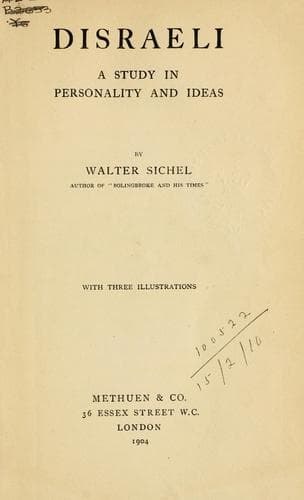
Disraeli: A Study in Personality and IdeasSichel, Walter
History
Disraeli: A Study in Personality and Ideas
Sichel, Walter
Disraeli, Benjamin, 1804-1881
Most of this in great measure he foresaw, and in all this has been
amply justified. What he did not anticipate was the enormous stature
which these developments have now reached. Multitudes of telling
instances might be given from those remarkable speeches, the pith and
point of which were always how this change would affect the labouring
classes. I will single out two alone, and both from that great speech
of 1846 on Mr. Miles’s amendment, which, in the light of the present,
reads like a continuous prophecy. Speaking of the displacement of
labour in connection with the then sparse distribution of the precious
metals, which he pointed out six years later must again modify the
situation owing to the recent and immense discoveries of gold, he said:
“... Every year and in every market English labour will receive less in
return of foreign articles. But gold and silver are foreign articles;
and in every year and in every market English labour will have less
command of gold and silver....” “... Supposing you import five millions
more from Russia than you ever did before, how will you make your
payments, if they take no more additional goods from you than they do
now?... I know it will be replied they manage these things by means of
bills and so on. But that will not improve the case. Suppose ... you
buy Russian bills on Brazil and New York to the amount of those five
millions, and you thus complete your transaction. But you have already
supplied the Americans and the Brazilians with as much of your goods as
you cared to take, and if you want to sell more to them, you must do so
at a great sacrifice....”
Once more, as regards foreign competition. He forecasted that of
America; and in demolishing the argument that Prussia’s protective
Zollverein was being “shaken;” he instanced Mecklenburg, induced by
English remonstrances to abstain from joining, but now complaining
that: “... After all the sacrifices we have made, if the Zollverein are
to have free importation to England, we have no advantage whatever, and
the best thing we can now do is to join and ... advance the cause of
native industry.”
Disraeli resolved that if the repeal became law, the burdens which
had been thrown on the land, because of the privileges which were its
ancient trust, should in fairness be mitigated; that it should compete
as freely as other manufacturers, for he never ceased to object to a
distinction, as manufacturers, between the farmer, the miller, and the
mill-owner.
Public-domain text, read in full here on John Shaqi.
Reviews
Reviews
No reviews yet
Be the first to share your thoughts on this work.
Elsewhere in the archive
Join the Discussion
Join the discussion
Sign in to leave a comment or review.
Sign InorCreate an account