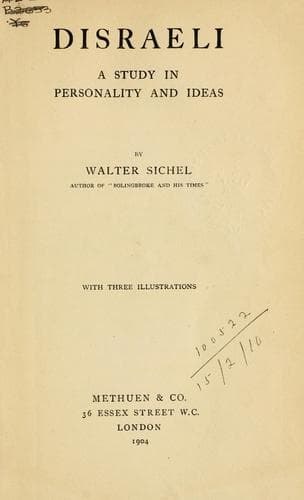
Disraeli: A Study in Personality and IdeasSichel, Walter
History
Disraeli: A Study in Personality and Ideas
Sichel, Walter
Disraeli, Benjamin, 1804-1881
These wholesale changes I cannot but feel that Disraeli would have
withstood. Many features in Mr. Chamberlain’s plan would have enlisted
his sympathy, but in their entirety he would have thought them
hazardous. Some protection for the grazier he might have upheld; he
always laid stress on the importance of home markets. A moderate duty
on corn, in partial, though most inadequate, aid of agriculture, he
might have favoured as a necessary lever for colonial reciprocity;
especially as it would be spread over the untaxed colonial, the foreign
dutiable imports. It would scarcely much affect the price of bread,
and the very Peelites forewent the fallacy of the dear loaf; although,
as in 1852, he would show that even a four shilling duty on imported
corn could never restore the land to its former footing. “We ought,”
he would again argue, “to go to the country on principle, and not upon
details. We say we think there should be measures brought forward”
(as since have been brought forward) “to put the cultivators of the
soil in a position to allow them to compete with foreign industry.”
What, however, he then urged with all his force was that the fiscal
revolution had confessedly caused vexatious taxes. “Sir,” he said in
1852, “I do now and ever shall look on the changes which took place in
1846, both as regards the repeal of the Corn Laws and the alteration
of the Sugar Duties, as totally unauthorised. I opposed them ... _from
an apprehension of the great suffering which must be incurred by such
a change_. That suffering in a great degree, though it may be limited
to particular classes, has in some instances been even severer than we
anticipated. But I deny that at any time after those laws were passed,
either I, or the bulk of those with whom I have the honour to act, have
ever maintained a recurrence to the same laws that regulated those
industries previously to 1846.” He then showed the difference between
Lord Derby’s proposed “fixed duty” and the old state of affairs; while
he continued: “... When we come to this question of fixed duty, ...
I must say now what I said before in this House, that I will not pin
my political career on any policy which is not after all a principle,
but a measure. Our wish is, that the interests which we believe were
unjustly treated in 1846,[84] should receive the justice which they
deserve, with as little injury to those who may have benefited more
than they were entitled to, as it is possible for human wisdom to
devise. _Sir, I call that reconciling the interests of the consumer
and the producer, when you do not permit the consumer to flourish by
placing unjust taxes upon the producer; while at the same time you
resort to no tax which gives to the producer; an unjust and artificial
price for his production._...”
Public-domain text, read in full here on John Shaqi.
Reviews
Reviews
No reviews yet
Be the first to share your thoughts on this work.
Elsewhere in the archive
Join the Discussion
Join the discussion
Sign in to leave a comment or review.
Sign InorCreate an account