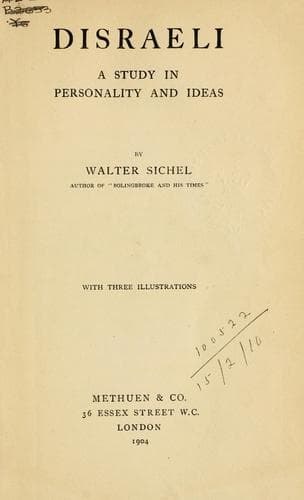
Disraeli: A Study in Personality and IdeasSichel, Walter
History
Disraeli: A Study in Personality and Ideas
Sichel, Walter
Disraeli, Benjamin, 1804-1881
Puritanism was cradled among small traders, conscious of their virtues,
but socially ill at ease. It at once became terribly at ease in the
courts of Zion. It began with a retail outlook, and it soon politicised
its creed. It became eminently republican, nor was it ever democratic.
Instinctively counter to all forms, whether “temporal” or “spiritual,”
it aimed at the destruction both of Monarchy and the Church, and yet
it set up an exclusiveness of its own. The Jewish Theocracy had, as I
have pointed out, broken down even under that monarchical shape which
suited it, just because its outward _State_ apparatus was mechanical
and out of touch with the development of national life. The finer
spirits of Puritanism--and they were very fine--had these features to
reckon with. Cromwell, like Savonarola, compassed an impracticable
solecism. He desired a Republican Theocracy. His scheme only chimed
with that of the Church which he sought to ruin in this, that he too
wished religion to be nationally organised--to be political. But the
result was an intolerant fanaticism of mutually persecuting sects, and
a Parliamentary censorship of morals which cramped, nay, imprisoned
self-developing virtue, confounded holiness with austerity, and
furnished the best argument for a “national Church.”
Milton, who tempered the Puritanic fire with the Renaissance light,
who, in his youth, was a worshipper of the subdued loveliness of the
Church and “her dim, religious light,” came to regard our national
Church as merely, in his own phrase, “an anti-papal schism.” Like
Cromwell, he longed to destroy it.
Public-domain text, read in full here on John Shaqi.
Reviews
Reviews
No reviews yet
Be the first to share your thoughts on this work.
Elsewhere in the archive
Join the Discussion
Join the discussion
Sign in to leave a comment or review.
Sign InorCreate an account