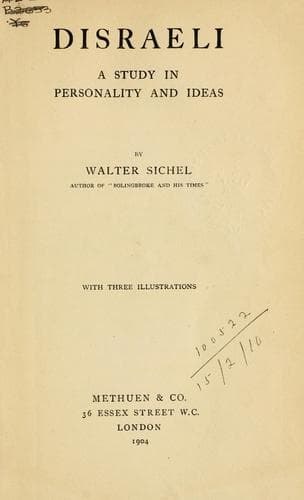
Disraeli: A Study in Personality and IdeasSichel, Walter
History
Disraeli: A Study in Personality and Ideas
Sichel, Walter
Disraeli, Benjamin, 1804-1881
“The Parliament of England,” he protests, had turned “regal bondage
into a free commonwealth.” “All Protestants,” he proceeds, “hold that
Christ in His Church hath left no vicegerent of his power, but Himself
without deputy is the only head thereof, governing it from heaven.” So
far Milton announces pure Theocracy; but the leaven of his classical
republicanism is disclosed in the next sentence: he cannot divorce
religion from politics. “How, then, can any Christian man derive his
kingship from Christ? I doubt not but all ingenuous and knowing men
will easily agree with me that a free commonwealth, without a single
person or House of Lords, is by far the best Government, if it can
be had.” And then he propounds grand councils of a perpetual senate,
safe-guarded against “any dogeship of Venice,”[92] as the means to
save the State. “The whole freedom of man,” he says, “consists either
in spiritual or civil liberty.” No rule for the first is admitted by
him but the Scriptures; for the second he takes the Dutch model of
the United Provinces. But he neglects to consider how liberty can be
settled without order, or order without discipline, or discipline
without authority, or authority without creed.
Even the loftiest Puritan ideal of Theocracy, therefore, was no less
political than that of the Church.
A very few years witnessed the complete breakdown of a system which
sought to blend the early Latin and the early Semitic ideals together
in unnatural alliance, and disregarded the native bias of Great
Britain.
The ensuing reaction rendered the English Church more political than
ever. She was split into contending partisanship for contending
dynasties. She repudiated James the Second, but not the Stuarts. Under
William of Orange latitudinarianism, even her latitudinarianism,
was militant. But under the two first Georges she grew torpid and
time-serving. The rash and rabid Sunderland, the astute Walpole,
parodied the old Miltonic ideals in their zeal for indifferentism,
and in self-defence the Church tended temporarily to seem the mere
stipendiary of the State, like an excise officer. But Wesley in
England, and Whitefield both here and in America, re-aroused the Church
to the higher and holier ideals of a _national_ Theocracy. Some century
later the Tractarian movement spurred her energies afresh, and they
have since been once more quickened in the battle with mechanical
materialism.
But all along it has been a sheer necessity in England--a necessity
for spiritual as well as civil _freedom_--that the State should lend
its earthly sanction of _order_ to the Church. A _national_ Church so
uncontrolled is impossible in England, where politics tinge every form
of aspiration. For international Theocracy, for that “millenary year”
which is the magnificent ideal of Romanism, the times are unripe. It
must remain a remote goal so long as the competitive egoism of nations,
transfiguring the baser egotism of individuals and of mere races, is
paramount.
Public-domain text, read in full here on John Shaqi.
Reviews
Reviews
No reviews yet
Be the first to share your thoughts on this work.
Elsewhere in the archive
Join the Discussion
Join the discussion
Sign in to leave a comment or review.
Sign InorCreate an account