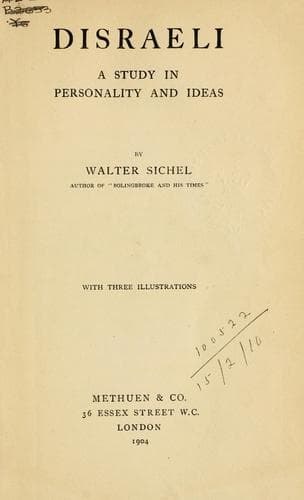
Disraeli: A Study in Personality and IdeasSichel, Walter
History
Disraeli: A Study in Personality and Ideas
Sichel, Walter
Disraeli, Benjamin, 1804-1881
The Church State has been unrealisable. England alone has realised
the State Church. The former has been impossible in the West, owing
to the Aryan genius for State development, and especially to the
national instinct of the Anglo-Saxon family. With the British spirit
a cosmopolitan religion is incompatible. No nation ambitious of being
a world-power can revert to Theocracy. It is not feasible under such
conditions.
The latter, however, the Anglican Church, has reconciled these two
concepts of opposite origins, the Oriental idea of a “Church,” and the
Occidental idea of the State. For it is not only a religious, but a
national and a social tradition.
This, I take it, was Disraeli’s attitude. By temperament he was
theocratic. He believed in the original spirituality of his race;
but he also believed in the great destiny of the nation to which he
belonged, and in her Church he descried the naturalised power of
Semitic ideas, the only form in which they could become nationally
operative, the sole political means in a political country of
sanctifying the secular. “The Church,” he once said, “is one of the few
great things left.” The Church ever found him a wise and enthusiastic
supporter. The fact is, as he put it in a speech of 1860, “the Church
is a part of England.” Nor would he ever allow that mere differences
of opinion negatived her comprehensiveness. She was still Anglican.
What he recoiled from was the hard-and-fast narrowness of Puritanism,
the fiercer fanaticisms of which, he always maintained, had undone
Ireland. Sectarianism is not strength, for strength resides in national
discipline. He regarded a “national Church” as the best pledge for
religious liberty to even those outside her communion, as a national
refuge from bigotry and a national rampart against priestcraft.
Public-domain text, read in full here on John Shaqi.
Reviews
Reviews
No reviews yet
Be the first to share your thoughts on this work.
Elsewhere in the archive
Join the Discussion
Join the discussion
Sign in to leave a comment or review.
Sign InorCreate an account