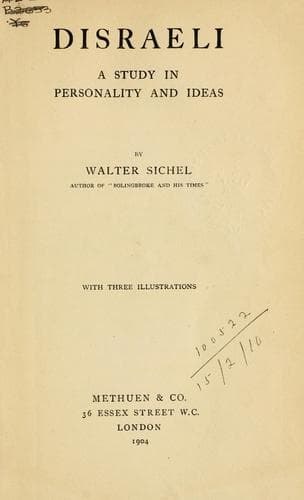
Disraeli: A Study in Personality and IdeasSichel, Walter
History
Disraeli: A Study in Personality and Ideas
Sichel, Walter
Disraeli, Benjamin, 1804-1881
“Now, sir,” he continued, with regard to disestablishment, “I myself am
much opposed to it, because I am in favour of what is called the union
between Church and State. What I understand by the union of Church and
State is an arrangement which renders the State religious by investing
authority with the highest sanctions that can influence the sentiments,
the convictions, and consequently the conduct of the subject; while,
on the other hand, that union renders the Church--using that epithet
in its noblest and purest sense--political. That is to say, it blends
civil authority with ecclesiastical influence; it defines and defends
the rights of the laity, and prevents the Church from subsiding into
a sacerdotal corporation. If you divest the State of this connection,
it appears to me that you necessarily reduce both the quantity and the
quality of its duties. The State will still be the protector of our
persons and our property, and no doubt these are most important duties
for the State to perform. But there are duties in a community which
rather excite a spirit of criticism than a sentiment of enthusiasm and
veneration. All, or most of the higher functions of Government--take
education, for example, the formation of the character of the people,
and consequently the guidance of their future conduct--depart from the
State and become the appanage of religious societies, of the religious
organisations of the country--you may call them the various Churches,
if you please--when they are established on what are called independent
principles.”
After welcoming the fact of a religious revival, he next continues:--
Public-domain text, read in full here on John Shaqi.
Reviews
Reviews
No reviews yet
Be the first to share your thoughts on this work.
Elsewhere in the archive
Join the Discussion
Join the discussion
Sign in to leave a comment or review.
Sign InorCreate an account