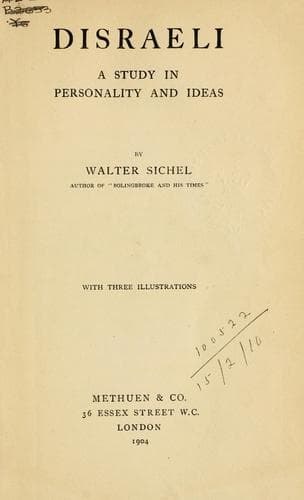
Disraeli: A Study in Personality and Ideas — John Shaqi
Disraeli: A Study in Personality and IdeasSichel, Walter
History
Disraeli: A Study in Personality and Ideas
Sichel, Walter
Disraeli, Benjamin, 1804-1881
Genius is both light and heat; it combines enthusiasm with insight.
Such a genius was Disraeli. He was eminently a man of ideas, and not
merely of abnormal perceptions. This distinction again is material, and
too often ignored.
The eminently perceptive man is at root a critic, while the man of
ideas is by prerogative a creator; and yet the quick perceiver is often
mistaken for a creative genius, and keenness confused with originality.
In politics, for instance, this was the case with such different
beings as Peel and Gambetta; in literature, with Addison and Arnold;
in art, with Kneller and Lawrence. Disraeli’s ideas were at once his
creations and companions, and he moved in their inner circle with a
sort of extravagant intensity. They were no shadows. He was convinced
of their substance almost to fatalism, and his immense will-power
forced and projected them into movement. In his extreme youth, before
his character had matured, these ideas flickered as fantasies. The
restlessness of a volition felt, but not yet freed or directed, caused
some masquerade of guise, and a perpetual strain on the intuition that
sought to forestall experience. Realisation alone, with power and
experience, brought repose. But at all periods an idea that had once
seized him tinged his whole being. Its reality haunted him till he
had given it place and shape.[7] An inward and ideal energy possessed
him. Ideas were for him far more tangible, even far more sociable,
than the outward and fleeting phantasms around him, as is evidenced
in his fiction by his constant habit of transferring environment and
transplanting personalities to accentuate their ideal essence. Thus, in
_Venetia_, the soul of Lady Byron animates the form of Shelley’s wife,
while the very date is put back some thirty years, that Shelley himself
might be enabled to have braved in action what he mused in poetry.
So, again, in _Contarini_, the hero’s development blends something of
his own with something of his father’s character; while Baron Fleming
is his grandfather reincarnated as a noble.[8] About the ironies of
these, the arabesques of his playful fancy flickered. For him they were
mostly the pretexts of things, but ideas were the causes, and he loved
to contrast “the pretext with the cause;” but even here romance blent
with irony, and invested the seemingly trivial with wonder. Some, too,
of his ideas hovered, as it were, over the present scene, in a flight
bound other-whither and beyond. In a word, Disraeli was an artist,
conscious and confident of an over-mastering call. As he has written in
a striking passage from the work of his youth, _Contarini Fleming_: “I
never labour to delude myself; and never gloss over my own faults. I
exaggerate them; for I can afford to face truth, because I feel capable
of improvement.... I am never satisfied.... The very exercise of power
teaches me that it may be wielded for a greater purpose.... No one
Public-domain text, read in full here on John Shaqi.
Reviews
Reviews
No reviews yet
Be the first to share your thoughts on this work.
Join the Discussion
Join the discussion
Sign in to leave a comment or review.
Sign InorCreate an account