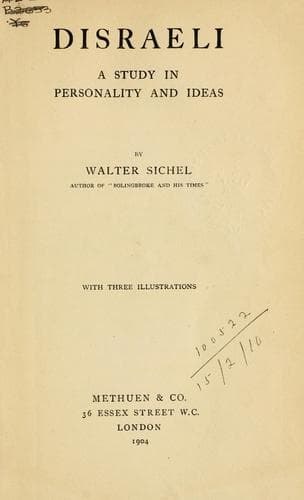
Disraeli: A Study in Personality and IdeasSichel, Walter
History
Disraeli: A Study in Personality and Ideas
Sichel, Walter
Disraeli, Benjamin, 1804-1881
In the stubborn pursuit of his aims Disraeli even courted unpopularity.
On every occasion when the object of the Jew bill was involved with
other measures which he considered prejudical to its due interests, he
risked misconstruction by withholding his vote. During the long spell
of 1859-66, when a dispirited, and sometimes disloyal following often
left him alone in his seat, he continued the pronouncements alike and
the reticence which they disrelished. During the six years previous
he dared to offend them equally by hammering the Government’s foreign
policy, and insisting on his own convictions. Nobody, again, more
regretted the precipitancy of Lord Derby in 1852, although his rash
assumption of office afforded Disraeli his first hard-won opportunity
of leadership. During three separate sets of discreditable intrigues
to dethrone him, he kept place, counsel, and temper without wheedling
concessions or recriminating revenges, though none could strike home
harder when he chose.
“... Ah, why should such enthusiasm ever die? Life is too short to be
little. Man is never so manly as when he feels deeply, acts boldly, and
expresses himself with frankness and with fervour.”
The fact that both the mere egotist, and the man of intense
personality, must, from the need of their respectively low and lofty
concentrations, be self-centred, and infuse their temperaments into the
objects of their energy, favours, it is true, the mistake to which I
have referred. But the one is pettily fixed on self, the other intent
on ideals. He leads a life of ideas which form his atmosphere, and
which emanate from it. He mounts the chariot to drive it to a distant
goal, while the other borrows or pilfers it for his own immediate
convenience. Egoism--if I may coin a distinction--is one thing, egotism
another. Goethe was an egoist--he is full of a radiating self; but such
egoism is, if we reflect, the very opposite of the egotist, who is full
of a shrivelled selfishness. Such were the later phases of Napoleon,
who changed from a generous imparter into an absorbing monopolist.
That was egotism. All genius, however, has been egoist, and ever will
be; for genius is at once the ear, sensitive to the subtlest appeals
of existence, and the voice which constrains others to enter the realm
of its ideas. Its sensitiveness is part of its strength, and in this
respect it shares the self-consciousness of the artist. It is in the
real sense auto-suggestive; it implants ideas which its will generates
into events. It is in some degree that--
“... which many people take for want of heart.
They err.--’Tis merely what is called mobility,
A thing of temperament, and not of art,
Though seeming so from its supposed facility;
And false though true; for surely they’re sincerest
Who are strongly acted on by what is nearest.”
And its faults, as I shall show in my closing chapter, are associated
with its very qualities.
Public-domain text, read in full here on John Shaqi.
Reviews
Reviews
No reviews yet
Be the first to share your thoughts on this work.
Join the Discussion
Join the discussion
Sign in to leave a comment or review.
Sign InorCreate an account