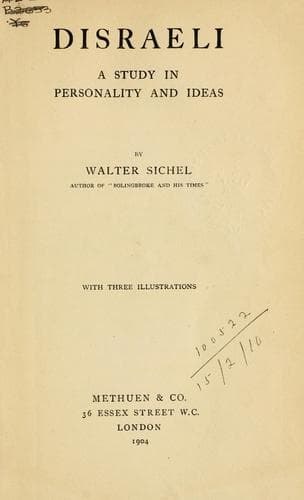
Disraeli: A Study in Personality and IdeasSichel, Walter
History
Disraeli: A Study in Personality and Ideas
Sichel, Walter
Disraeli, Benjamin, 1804-1881
yet throughout the brief and perplexed span of his reign he honestly
tried to accord with the whole nation as opposed to cliques and
sections of it that assumed the title of “the people.” The fact was
that he acceded during one of those crises when the balance of power
was shifting, and, his intellect being mediocre, he became bewildered.
The new, the legitimate, the organised predominance of public opinion
clashed with Parliament, and was played upon by ambitious ministers.
William the Fourth lived in just fear and blunt defiance of that
“Venetian oligarchy” which ever since 1704 had been the recurrent ideal
of the place-engrossing, great revolution families. What he apprehended
was foiled, principally by the personality of Sir Robert Peel, whom
he summoned to his aid. Henceforward the monarchy became, as it ought
long before to have become, completely, if gradually, popularised. When
monarchy is popular, the invisibility of its office ceases to be an
expedient. “... I think,” said Disraeli, in a speech of 1850, “it one
of the great misfortunes of our time, and one most injurious to public
liberty, that the power of the Crown has diminished.”
With Victoria and our present King--if we except a very transient spasm
of George III., whose first essay to be a “patriot king” had been to
dismiss and thwart the most popular minister that England has ever
had--monarchy has for the first time during nearly two centuries proved
wholly and nationally popular. Before the Stuarts, Elizabeth had ruled
by the sole virtue of her popularity; she had “inflamed the national
spirit,” and the checks introduced by the Revolution were only a
necessity for unpopular sovereigns. The Press has now introduced a far
greater check than any of these. Now that the nation is in full unison
with the Crown, the King is doubly entitled to support the nation
in hours of befitting emergency against the cabals or passions of a
person, a clique, or a class. A modern English King is too cognisant of
the popular feeling eloquent in an unbridled press ever to violate it;
he could not do so with impunity. The last surrender of “independent
kingship,” which Mr. Gladstone has noted, and others after him, was in
1827, when a weak sovereign renewed the “charter of administration of
the day.” There is no pretext now for a King to yield or hide his just
and popular privileges to serve the turn of ministers. The necessity
for a “monarch of Downing Street” has disappeared.
Disraeli adverted to some of these topics at Manchester in 1872, long
after the events of those times had passed, but when “the banner of
republicanism” was once again unfurled.
Public-domain text, read in full here on John Shaqi.
Reviews
Reviews
No reviews yet
Be the first to share your thoughts on this work.
Elsewhere in the archive
Join the Discussion
Join the discussion
Sign in to leave a comment or review.
Sign InorCreate an account