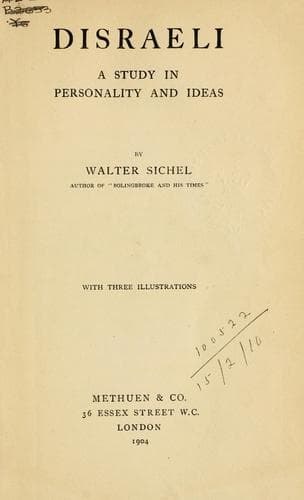
Disraeli: A Study in Personality and IdeasSichel, Walter
History
Disraeli: A Study in Personality and Ideas
Sichel, Walter
Disraeli, Benjamin, 1804-1881
“... Since the settlement of that constitution, now nearly two
centuries ago, England has never experienced a revolution, though
there is no country in which there has been so continuous and
such considerable change. How is this? Because the wisdom of your
forefathers placed the prize of supreme power without the sphere of
human passions. Whatever the struggle of parties, whatever the strife
of factions, whatever the excitement and exaltation of the public
mind, there has always been something in this country round which all
classes and powers could rally, representing the majesty of the law,
the administration of justice, and involving at the same time the
security for every man’s rights and the fountain of honour.” And then,
after emphasising the non-partisanship of the Crown, the very end which
Bolingbroke forecasted at the time when an unemancipated King was
condemned to be a party man, he led the discussion to the conventional
views of the King being not only outside politics, but outside affairs.
“... I know it will be said that, however beautiful in theory,
the personal influence of the Sovereign is now absorbed in the
responsibility of the minister. I think you will find there is a great
fallacy in this view. The principles of the English Constitution do
not contemplate the absence of personal influence on the part of the
Sovereign; and if they did, the principles of human nature would
prevent the fulfilment of such a theory.” He is here in complete accord
with Peel. “Even,” he says, “with average ability, it is impossible
not to perceive that such a Sovereign must soon attain a great mass
of political information and political experience. Information and
experience, ... whether they are possessed by a Sovereign or by the
humblest of his subjects, are irresistible in life.... The longer the
reign, the influence of that Sovereign must proportionately increase.
All the illustrious statesmen who served his youth disappear. A new
generation of public servants rises up. There is a critical conjuncture
in affairs--a moment of perplexity and peril. Then it is that the
Sovereign can appeal to a similar state of affairs that occurred
perhaps thirty years before. When all are in doubt among his servants,
he can quote the advice that was given by the illustrious men of his
early years, and though he may maintain himself within the strictest
limits of the Constitution, who can suppose, when such information and
such suggestions are made by the most exalted person in the country,
that they can be without effect? No; ... a minister who could venture
to treat such influence with indifference would not be a Constitutional
minister, but an arrogant idiot....” And in another speech of the same
year, after insisting that English attachment to English institutions
was no “political superstition,” but sprang from a resolve that “_the
principles of liberty, of order, of law, and of religion ought not to
Public-domain text, read in full here on John Shaqi.
Reviews
Reviews
No reviews yet
Be the first to share your thoughts on this work.
Elsewhere in the archive
Join the Discussion
Join the discussion
Sign in to leave a comment or review.
Sign InorCreate an account