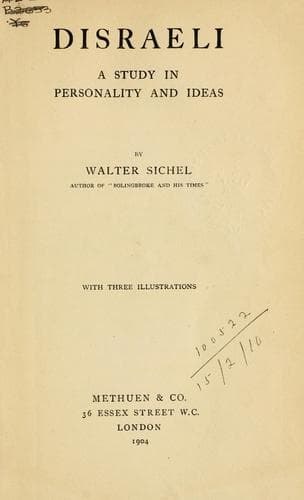
Disraeli: A Study in Personality and IdeasSichel, Walter
History
Disraeli: A Study in Personality and Ideas
Sichel, Walter
Disraeli, Benjamin, 1804-1881
be entrusted to individual opinion, or to the caprice and passion of
multitudes, but should be embodied in a form of permanence and power_,”
he also remarked: “... We associate with the Monarchy the ideas which
it represents--the majesty of law, the administration of justice, the
fountain of mercy and honour.” He might, in fitness with his other
pronouncements, have added the ideas of loyalty and of leadership.
Again, in 1871, a moment of republican revival, adverting to the
superintendence of public business by the Sovereign, he insisted that
“... there is not a dispatch received from abroad, or sent from this
country abroad, which is not submitted to the Queen.... Those Cabinet
Councils, ... which are necessarily the scene of anxious and important
deliberations, are reported and communicated, ... and they often call
from her critical remarks requiring considerable attention.... No
person likely to administer the affairs of this country would treat
the suggestions of Her Majesty with indifference, for at this moment
there is probably no person living who has such complete control over
the political conditions.... But, although there never was a Sovereign
who would less arrogate any power or prerogative which the Constitution
does not authorise, so I will say there never was one more wisely
jealous of those which the Constitution has allotted to her, because
she believes they are for the welfare of her people.”
It is by its constitutional prerogatives that, in the first place, the
Crown can assert its lawful influence. They confer on him a deciding
power in many spheres. Of these prerogatives Disraeli was a champion;
and Mr. Gladstone upheld them in at least two interesting discussions
among his “Gleanings.”
To defer the most obvious among these, the King’s consultative faculty,
“the power,” to cite Mr. Gladstone, “which gives the monarch an
undoubted _locus standi_ in all the deliberations of a Government, ...
remains as it was.” In olden days this was effected openly in form. Nor
should it be forgotten that whenever a Ministry is changed, again to
cite Mr. Gladstone, “the whole power of the State periodically returns
into the royal hands.” In 1852, when Lord Derby reluctantly consented
to assume office with a minority, there were forty-eight hours when,
as Disraeli pointed out in a speech of 1873, “the Queen was without
a Government.” Then take the royal prerogative of dissolution. This
right enabled, in 1852, that very administration to perform the work
of the session, and to carry the supplies before appealing to the
constituencies on its right to exist. It is in effect a right of appeal
by the Sovereign through or even against (should he deem it their
duty to take the national voice) his ministers to the country; and in
any crucial instance it forms the best check to faction of which our
Constitution admits.
Public-domain text, read in full here on John Shaqi.
Reviews
Reviews
No reviews yet
Be the first to share your thoughts on this work.
Elsewhere in the archive
Join the Discussion
Join the discussion
Sign in to leave a comment or review.
Sign InorCreate an account