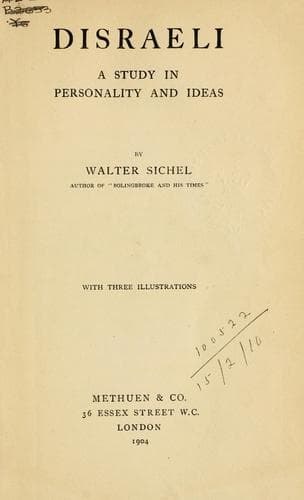
Disraeli: A Study in Personality and IdeasSichel, Walter
History
Disraeli: A Study in Personality and Ideas
Sichel, Walter
Disraeli, Benjamin, 1804-1881
Further, there exists the admitted prerogative, openly exercised, of
choice of ministers. This was the main arena of party cleavage under
the greater portion of the sway of George III. It was this which,
as Mr. Gladstone also mentions, was unsuccessfully, but neither
unwholesomely nor unfairly, pressed into popular service in 1834.
And, among many others remaining, there is that to appoint bishops--a
stalking-ground of contention during the reign of Anne, and, in the
Victorian era, signalised by Dr. Hampden’s appointment against a
remonstrant primate. There is the prerogative of the Royal Warrant
utilised by Mr. Gladstone himself in the repeal of the Purchase Act.
There is the prerogative of disapproving the choice of Speaker, which
will probably cease. There is that for proposing grants of public
money, and there is the salutary initiative of Royal Commission which
paves the way for social reform. On these personal rights I need not
dwell. But on the prerogative of peace and war a word must be said. Had
it been withheld for hostilities in the Crimea, a needless complication
of Europe need never have occurred.[111] We may conjecture that its
influence was not absent from our recent peace in South Africa. Mr.
Gladstone has instanced the Chinese war, some fifty years ago, as an
example of carrying on a conflict believed to be necessary despite its
condemnation by “the stewards of the public purse.” The Sovereign has
also the undoubted right to consult with his ministers, and to attend
the deliberations of his Cabinet. Queen Anne did this habitually, and
the fatal movement of her fan decided great issues on more than one
occasion. The first two Georges used on occasion, but with indifference
where money was not concerned, to do the same. Since then it has fallen
into disuse, and perhaps the end is better served by the premier’s
audiences with his King. But I may here be permitted to hope that when
the great intercolonial council which is in the air has taken shape,
the Sovereign may deign to be its President. Such a decision would be
in complete accord with the policy of Disraeli, who affirmed in 1876,
“No one regrets more than I do that favourable opportunities have been
lost of identifying the colonies with the royal race of England.”
The prerogatives are the royal faculties for independent expression.
But it is obviously not by prerogative mainly or alone that the Crown
rivets and can mould a nation. The Crown is a many-sided emblem. It is
the centre of English unity, a focus of consolidation and compactness;
while it also represents Great and Greater Britain abroad. As a source
of home sympathy, as the embodiment of the might and mercy of a great
Empire, as the durable impersonation of the individual character that
out of many welded races creates a united Empire, it is manifestly
operative. I may add that it may also set an example of simplicity, for
the Crown is able to bring choice virtues into vulgar fashion.
Public-domain text, read in full here on John Shaqi.
Reviews
Reviews
No reviews yet
Be the first to share your thoughts on this work.
Elsewhere in the archive
Join the Discussion
Join the discussion
Sign in to leave a comment or review.
Sign InorCreate an account